Enterprise-Centric AI Feature Strategy
We align feature engineering with core business KPIs, contributing to measurable outcomes like improved conversions, reduced churn, or enhanced operational efficiency.

At TestingXperts, we specialize in embedding AI into the heart of your enterprise systems. Our AI Feature Engineering service modernizes legacy platforms and accelerates decision-making with intelligent, context-aware capabilities. From integrating GenAI features to automating complex workflows, we engineer practical AI into your existing tech stack. TestingXperts bridges the gap between cutting-edge AI and enterprise readiness—securely, efficiently, and impactfully.
Whether it's smarter search, adaptive recommendations, or predictive insights, we work closely with you to identify high-impact use cases where AI delivers measurable value. Our solution fits your business context, ensuring AI doesn't just function, but truly performs. With a focus on usability and scalability, we help you turn data and processes into intelligent products that meet your needs.
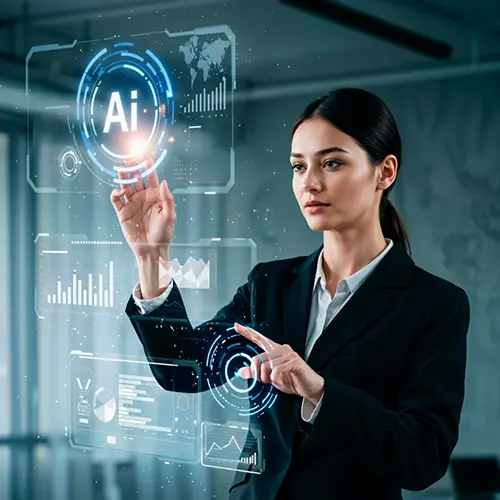






Use LLMs (Claude, GPT-4, Gemini) to extract features from SAP logs, legacy CRMs, and business documents.

Implement continuous monitoring using SHAP, Allure, and LLM-based adaptive feature recalibration.

Integrate interpretable layers (SHAP, LIME) with audit-ready logging using Azure ML or SageMaker.
Leverage large language models like Claude, GPT-4, and Gemini to extract, enrich, and contextualize features from text-heavy sources like support logs, survey data, and business documents.
Design and tune high-precision AI prompts that guide GenAI tools to generate domain-specific, high-precision features aligned with model objectives.
Auto-discover and validate features across Salesforce, SAP, and ServiceNow Using GenAI frameworks hosted on AWS Bedrock and Azure ML.
Leverage GenAI models and LLMs (OpenAI, Claude, Gemini) to refactor pipelines, enhance interoperability, and accelerate enterprise AI-readiness while managing the capability vs latency trade off.

Continuously track feature relevance, stability, and predictive power using AI-powered telemetry and integrated dashboards (e.g., Kibana, Prometheus, Allure).

Standardize and align features across siloed platforms like Salesforce, SAP, and ServiceNow using LLMs to ensure consistency, interoperability, and downstream model compatibility.

We align feature engineering with core business KPIs, contributing to measurable outcomes like improved conversions, reduced churn, or enhanced operational efficiency.

Our experts infuse industry-specific knowledge into feature design, creating context-aware, high-precision features that drive relevance and accuracy across different sectors.

Using proprietary frameworks and AutoFE pipelines, we automate feature creation while accelerating deployment without compromising control.

Features are engineered with MLOps compatibility, enabling smooth integration into CI/CD pipelines, and monitoring for sustained model performance in production.








The best AI feature engineering service really helps to get models in production by shortening the time it takes to train and test them, lowering the risks involved in deploying them. This makes sure that data feeding into your models is consistent and in line with business goals. This gives teams a lot more confidence in putting their models into production.
Poor data quality, irrelevant or noisy features in your data, and datasets that are loaded with bias- these are just a few things that can end up producing less accurate models. Even the most advanced algorithms are going to struggle if the features they’re using to learn from don’t line up with how things actually work in the real world.
Feature engineering is about taking raw data and turning it into something that gives your model useful information to learn from. This means choosing and creating the right features – ones that show patterns that your model can pick up on. The result is you get models that are more accurate, less likely to get too complex and overfit, and better at predicting things you haven’t seen before.
Businesses see results like faster testing, models that are more reliable and less prone to problems, less time wasted on rework, and – most importantly – models that are actually aligned with what they’re trying to achieve. These specialists bring domain knowledge, proven techniques, and the ability to scale up their work so that models can move smoothly from the testing phase to being in full production mode.
The best AI feature engineering service really helps to get models in production by shortening the time it takes to train and test them, lowering the risks involved in deploying them. This makes sure that data feeding into your models is consistent and in line with business goals. This gives teams a lot more confidence in putting their models into production.





See What Clients Are Saying About Us!
4.7/5.0
Overall Rating
"We have had a successful partnership with TestingXperts for many years. The testing team has been efficient, precise, and crucial in the launch of many sites."
See All Reviews(Resource Planner, IT services)
Get a Consultation