Artificial intelligence (AI) has advanced rapidly over the last few years and is still progressing to transform the fundamentals of how we see and experience things around us. This technology has introduced an entirely new line of methodologies for operating, innovating, and creating at a speed and scale never seen before. However, with such transformative power comes the responsibility for AI governance practices.
One point that enterprises need to understand is that the AI pilot phase is over. 2026 will be the year when AI will move from an interesting tech to an operational infrastructure. Many organizations are already using it as a process management and running body to handle their enterprise flow. However, to ensure AI’s credibility and robustness, businesses need a strong AI governance framework that will assist in staying ahead of the AI implementation race.
From Innovation to Industrialization: Why is AI Governance Critical for 2026?
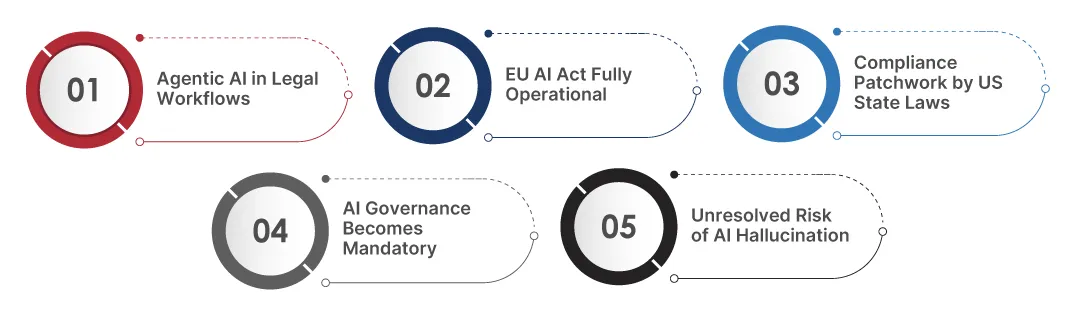
As per Gartner predictions, 40% of enterprise applications will have task-assigned AI agents by 2026. Core functions, such as payment workflows, internal team coordination, customer support, and compliance checks, will be handled by AI applications, while humans will be reserved for oversight and decision-making. However, this level of autonomy without any gatekeeping will not limit AI’s adoption. Here are some factors defining why AI governance is non-negotiable in 2026:
Agentic AI in Legal Workflows:
AI agents are executing multiple tasks autonomously, marking a significant technical shift this year. For instance, LexisNexis’s next-gen AI assistant for legal professionals deploys specialized agents – an orchestrator, a research agent, a web search agent, and a customer document agent.
EU AI Act Fully Operational:
August 2026 will mark the month when the EU AI Act becomes fully operational for high-risk systems, including those in the legal services sector. If an organization fails to comply with the act, it will incur a penalty of €35 million or 7% of its global revenue. Organizations must integrate risk management systems and ensure that human involvement is incorporated.
Compliance Patchwork by US State Laws:
To ensure transparency for high-risk AI systems, implement risk management policies, and drive assessments, the Colorado AI Act will take effect in June 2026. Additionally, Illinois’ AI in Employment Law requires transparency when organizations use AI in employment decision-making.
AI Governance Becomes Mandatory:
Organizations must formalize AI policies to address brand, PII, and ethical risks. There’s already a framework (ABA Formal Opinion 512) that requires lawyers to have a basic understanding of AI usage, its capabilities, and limitations.
Unresolved Risk of AI Hallucination:
There are over 700 court cases worldwide related to AI hallucinations. Building an AI governance framework is now mandatory, and human involvement will become obsolete as a means to address this technical limitation.
Understanding the Growing Risks and Regulations
The regulatory bodies observing AI working have matured significantly. Most of the provisions, including those for general-purpose AI and high-risk systems, are now prompting state governments to ensure the ethical use of AI solutions within their jurisdictions. Failing to comply with AI regulatory mandates or localized laws also carries a severe financial and reputational burden. Laws such as the EU AI Act, the US Algorithmic Accountability Act, and the Digital India Act aim to create an umbrella network for a global patchwork. The risk of ignoring the AI governance and regulations includes:
AI systems can introduce biases if not carefully managed and monitored. A lack of governance leads to biased AI algorithms that negatively impact a brand’s reputation and trustworthiness.
AI systems without transparency will be considered Black Boxes by higher-ups. Without any details regarding AI decision-making capabilities, the stakeholders’ trust in AI-powered solutions can erode.
Without human oversight or governance frameworks, AI models can stray from their intended objectives. It includes operational efficiencies, data breaches, and reputational damage.
As AI models become general-purpose and integrated across industries, regulations and governance will be the key players in the enterprise AI strategy. The key challenge in 2026 would be whether the regulatory bodies can keep up with AI systems that open a new horizon for traditional sectors.
How to Transform AI Governance from Risk Management to Opportunity?
There’s a common myth related to governance that it hampers innovation, which is wrong. A robust AI governance framework provides limits and safety protocols that enable you to move faster. It helps you shift from reactive compliance to a proactive strategy by integrating AI into core GRC (Governance, Risk, Compliance) functions.
From Cost Center to Value Driver:
Create a detailed roadmap to sync AI initiatives with your business objectives and move to core value creation. Utilize proactive risk-to-opportunity mapping to transform compliance challenges into competitive advantages.
Integrate AI for Operational Excellence:
Initiate automated risk intelligence with AI and enable real-time monitoring and analysis of datasets. It will also help bridge gaps between IT, risk, and compliance structures.
Turn Governance into Process Enabler:
Note down roles and policies for decision-making processes to ensure accountability for AI usage. Use a human-in-the-loop model to build trust and ensure ethical outcomes for AI decision-making.
Key AI Governance Practices in Large Enterprises
At the enterprise level, the stakes for AI governance are very high. It requires a systematic approach followed by key practices that are given below:
Define roles for AI models and assign responsibilities for their oversight and outcomes. It will majorly involve tech, legal, and risk management teams.
Follow an Explainable AI approach to understand, document, and audit AI models’ decisions. It will ensure traceability of AI solutions, especially for GenAI.
Conduct bias testing on the diverse data and simulations used to train AI models, ensuring fairness in the final results. It will help you deliver equitable outcomes.
Handle data security and quality for AI training by implementing encryption and anonymization methods. It will cover data lineage, metadata, and privacy controls.
Include cybersecurity testing to secure sensitive data and AI systems from breaches. Ensure your AI models comply with the GDPR, EU AI Act, and other relevant industry standards.
Ensuring Compliance and Trust with TestingXperts AI Governance Expertise
As AI becomes a core application of enterprise decision-making, ensuring its responsible use is a much-needed activity. In 2026, AI is expected to transition from the implementation stage to the operational stage, so organizations must have comprehensive governance frameworks integrated within their AI pipelines. At TestingXperts, our AI governance solutions enable you to seamlessly manage AI risk and ensure compliance across the entire lifecycle.
As a leading AI governance company, we help businesses ensure the ethical use of AI by implementing bias mitigation strategies, explainable frameworks, risk management, and auditability. Our approach involves:
Integrating guardrails into the AI workflow
Conducting AI bias testing
Automated compliance checks in accordance with global AI regulations
Explainability frameworks and stakeholder auditability
Real-time governance across the model lifecycle
Do you want to ensure the ethical usage of your AI models in 2026 and beyond? Contact TestingXperts AI experts to know the real risks of ignoring AI governance and why you should invest in it.
Conclusion
As AI continues to play a central role in shaping the future of business, AI governance will become increasingly vital. In 2026, it is no longer an optional practice but a necessity for enterprises looking to protect themselves from risks, comply with evolving regulations, and build trust with stakeholders. If you want to ensure that your business stays ahead of the curve, it’s time to invest in a comprehensive AI governance framework. At TestingXperts, we are here to help you navigate the complexities of AI governance and create solutions that drive both compliance and innovation.
Michael Giacometti is the Vice President of AI and QE Transformation at TestingXperts. With extensive experience in AI-driven quality engineering and partnerships, he leads strategic initiatives that help enterprises enhance software quality and automation. Before joining TestingXperts, Michael held leadership roles in partnerships, AI, and digital assurance, driving innovation and business transformation at organizations like Applause, Qualitest, Cognizant, and Capgemini.
FAQs
What should an enterprise AI governance framework include?
An enterprise AI governance framework must include the following parameters:
Inventory of AI systems
Risk classification
Policy controls (data, privacy, human oversight)
Documented model decisions
Bias/safety testing
Continuous monitoring for drift
Incident reporting and audit logs
What’s the big enterprise challenge for regulators in 2026?
Some of the biggest enterprise challenges for regulators in 2026 would be to ensure enforcement at scale, which involves:
Validating risk classifications
Documentation, monitoring, and incident reporting
Coordinating market surveillance
Aligning guidance for general-purpose AI and high-risk systems
What specific AI governance services does TestingXperts provide?
TestingXperts AI governance portfolio involves:
AI Policy & Compliance Frameworks
Bias Detection & Mitigation
Model Explainability & Transparency
AI Risk & Impact Assessments
Lifecycle Monitoring & Model Management
Responsible AI Training & Change Enablement
Why should we invest in AI governance services specifically for the 2026 scale-up?
EU AI Act obligations expand toward August 2026, and governance work needs lead time. Investing ahead prevents rushed fixes, release delays, and compliance gaps when AI moves from pilots to many teams and products.
What is your recommended enterprise operating model for AI governance ownership?
TestingXperts enterprise operation model for AI governance ownership involves:
An AI Governance Office sets policy and approvals
Each AI product team owns controls, testing, and monitoring
Legal/privacy, security, compliance, and internal audit run independent reviews and evidence