

Recommended Blogs

TCoE Automation Integration: How DevOps and Automation Powers Testing
Table of Content
- The TCoE Dilemma: Stagnation vs. Evolution
- DevOps and Automation: The Catalysts for TCoE Innovation
- Breaking Testing Bottlenecks: The Power of DevOps Integration
- The Role of Automation in Scaling TCoE Efficiency
- Fostering a Continuous Delivery Pipeline with DevOps and Automation
- Why TestingXperts: Leading the Charge in TCoE Innovation
Share On


A report from 2025 just dropped, and it’s clear that the industry is on a roll, 88 percent of businesses are now using AI in at least one area, with adoption rates skyrocketing across the globe.
If your organization is trying to take the road to automated, intelligent testing activities, but your TCoE is still stuck in the stone age, you’re in a world of trouble. The gap between what your customers expect from modern delivery and what your legacy testing is still chugging out is getting wider by the day. And QA teams that are refusing to budge and keep their TCoE stuck in old habits are going to pay the price, more defects, stretched timelines and astronomical operational costs.
So how do you stay on the right track and keep up with the pack? The secret to success lies in getting your TCoE to evolve and move with the times – and the best way to do that is to root it firmly in DevOps and automation. A model that’s all about speed, reliability, and consistent quality is the only way to go.
The TCoE Dilemma: Stagnation vs. Evolution
Some testing centers are still running their testing on heavy manual testing cycles; test data is scattered all over the place, and every team is doing their own little thing, disconnected from the rest. And then, just when the release is about to happen, all hell breaks loose.
So, what tends to suffer in a stagnant TCoE?
By enabling project teams to adapt and align testing practices to their specific needs while maintaining enterprise-wide standards, organizations can promote collaboration, consistency, and the sharing of best practices across development teams.
Bottlenecks That Stall Delivery
Quality Assurance waits for development; development waits for environments, and everyone waits for the bloody report.
Outdated, Documentation-Heavy Testing
Documentation-driven testing puts everyone in a rut. The test automation center of excellence is as good as fully automated, or it’s still stuck in the dark ages.
To break out of outdated, documentation-driven testing cycles and drive innovation, it’s essential to implement QA best practices.
High Costs From Inefficient Processes
Manual testing, repeated rework and firefighting all just add to your Total Cost of Ownership. Shouldn’t automation be cutting it down instead?
Modern Testing Center of Excellence (TCoE) models that leverage automation and hybrid approaches can drive cost efficiency by balancing in-house control with outsourced execution.
Testing That Fails to Meet Real Needs
Multiple QA teams rewrite the same tests repeatedly, and regression barely keeps up, no wonder it’s so inconsistent.
It’s totally out of sync with the realities of cloud-native, microservices or multiple releases a week, isn’t it? A modern TCoE needs to be able to move fast, with shared pipelines, Everything as Code and all the other bells and whistles that come with modern IT. And that’s where DevOps and automation really come into their own.
Implementing standardized testing processes can significantly reduce redundancy and improve consistency across teams.
DevOps and Automation: The Catalysts for TCoE Innovation
Let’s put it in perspective. DevOps brings together dev, QA and testing operations in a beautiful collaboration and shared responsibility. Automation brings the scale, and together, they give your TCoE the legs to really move.
Automation engineers play a critical role in developing, implementing, and maintaining automated testing strategies within a Testing CoE, contributing significantly to orchestration and standardized processes across teams.
Here’s just how the combo shapes a modern TCoE model.
DevOps Brings It All Together
No more than three teams pulling in three different directions, DevOps practices for QA automation mean a single flow that everyone works within, all aiming for the same quality goals and delivery rhythm.
Test Automation Makes Testing Tick
Automation in TCoE isn’t about replacing testers; it’s about having people focus on the really important stuff. It frees them up from drudgery and gets them to do what they do best – critical thinking. Automation improves repeatability, consistency, and test coverage. By defining and tracking automation coverage, teams can ensure that the extent and scope of automated testing are maximized, leading to more comprehensive and effective testing results. This also reduces effort.
CI CD and Continuous Testing Take Center Stage
CI/CD pipelines become the backbone of the new TCoE and tests start running automatically every time a change is pushed through. That way, issues surface early on, and fixes are much cheaper and cleaner to implement.
In short, DevOps makes a TCoE run like clockwork, and automation gives it the reach it needs, and when you put them together, you get the evolution that so many teams have been missing out on.
Breaking Testing Bottlenecks: The Power of DevOps Integration
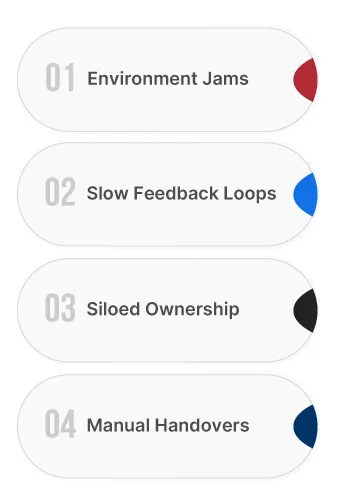
Bottlenecks usually seem to pop up in four main areas – builds, environments, test execution and reporting – and when DevOps comes into play, each and every one of them becomes smoother and more predictable.
So, here’s what DevOps does to sort out the TCoE. By enabling development and QA to work together in a unified pipeline, DevOps also empowers testing teams within the TCoE. These testing teams are reskilled and structured to enhance efficiency, consistency, and strategic alignment across enterprise testing initiatives.
Environment Jams
Automated provisioning and test environment management cut down waiting time dramatically.
Slow Feedback Loops
Integrated pipelines get results back to the team quickly, so they can respond rather than just react.
Siloed Ownership
With shared dashboards, repositories, and accountability, collaboration just becomes easier.
Manual Handovers
Automated triggers sort out most handovers, so teams don’t spend hours chasing after updates – they can just act on the insights they get.
In real-world testing centers, when development and QA are working together in a unified pipeline, release cycles get shorter, defects get fewer, and teams allocate more time for exploratory testing, just what they need to innovate.
The Role of Automation in Scaling TCoE Efficiency
Automation just takes what manual processes can’t deliver to the limit. It eliminates bottlenecks that human-dependent workflows create and lets the TCoE grow without adding a single extra headcount. By optimizing existing testing resources, the TCoE can further enhance performance and efficiency, making better use of what is already available.
Key Areas Where Automation Really Boosts Tcoe Performance
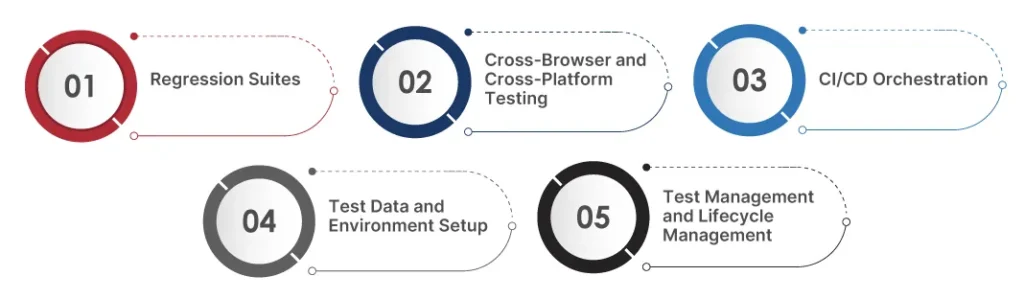
Regression Suites
Large, repetitive test suites that used to take days can now run in minutes.
Cross-Browser and Cross-Platform Testing
Automation TCoE frameworks that DevOps teams use are great at running tests consistently across all sorts of devices and environments.
CI/CD Orchestration
Automation keeps releases solid and reliable every time.
Test Data and Environment Setup
Scripted provisioning supports Everything as Code in automation.
Test Management and Lifecycle Management
Test automation lifecycle management ensures tests stay versioned, maintainable and up to speed with the evolving codebase.
And all of that means a much healthier automation ROI for the TCoE. Organizations get really consistent coverage without a huge effort, reduce QA costs by retiring old manual workflows and gain the ability to scale the TCoE with DevOps, no problem.
Fostering a Continuous Delivery Pipeline with DevOps and Automation
A continuous delivery pipeline flips the automation scripts on how teams think about quality. Quality stops being something you check at the very end and becomes a consistent practice that’s woven into every single commit.
That mindset has some really tangible benefits.
Shorter Release Cycles
Our CI CD pipelines enable teams to ship smaller increments more regularly. These shorter release cycles contribute to a faster time to market, demonstrating the business value of centralized testing initiatives. That’s the idea behind a TCoE.
Higher Confidence
With automated gates and quality checks in place, you don’t have to worry as much about releases; you can actually be confident in what you’re putting out there.
Improved Collaboration
Sharing metrics really helps teams align on what matters – business outcomes – not just defect counts.
Stronger Customer Experience
Faster feedback loops mean customer issues get resolved fast, and you can deliver more updates sooner.
Better Control of Test Environments
Having standardized, automated environments means you’ve reduced variability and failures caused by inconsistent setups.
All in all, continuous delivery makes the Test Center of Excellence a strategic driver of release velocity and product quality, not some inspection booth at the end of the process.
Why TestingXperts: Leading the Charge in TCoE Innovation
TestingXperts are the ones who can help organizations move away from those legacy testing models and towards some forward-thinking, automation-driven TCoEs that are designed for scalability. They also support organizations in building and implementing an effective testing center of excellence to improve software quality and testing processes. They bring a unique blend of deep domain expertise and a real understanding of how to integrate DevOps toolchains and automation frameworks.
How We Can Help You With TCoE Setup Services
- Customized strategies for seamless integration of DevOps and automation in TCoE
- Proven accelerators for building an automation strategy for the TCoE model
- A strong focus on keeping the total cost of ownership as low as possible with DevOps and automation
- Test management tools and playbooks that simplify managing TCoE transformation with automation and DevOps
- Expertise in integrating CI CD, continuous testing, environment management, and reusable automation assets
- Expertise in standardizing and optimizing QA processes within TCoE engagements to ensure consistency, scalability, and alignment with business goals and industry best practices.
TestingXperts has helped enterprises across a range of different industries boost test delivery through DevOps in TCoE, optimize efficiency in TCoE using DevOps practices, and set up scalable automation foundations that meet modern delivery expectations.
If you want a future-ready testing center that can support faster releases, stronger coverage, and a healthier cost structure, TestingXperts is the partner that can help you get there.
When it comes to AI, the quality of the data it’s based on is everything. If you don’t put in the testing effort to test data rigorously, your AI is only going to work as well as that data is good. Thats the difference between getting reliable intelligence and costly blind spots.
When you build consistent validation into every stage of your software lifecycle, you transform uncertainty into confidence, and you start to get real results faster. If you want an AI that can learn, scale and surprise you less, then TestingXperts can help you. With our expertise, we are ready to assist you and ensure business success.


Manjeet Kumar
VP, Delivery Quality Engineering
Manjeet Kumar, Vice President at TestingXperts, is a results-driven leader with 19 years of experience in Quality Engineering. Prior to TestingXperts, Manjeet worked with leading brands like HCL Technologies and BirlaSoft. He ensures clients receive best-in-class QA services by optimizing testing strategies, enhancing efficiency, and driving innovation. His passion for building high-performing teams and delivering value-driven solutions empowers businesses to achieve excellence in the evolving digital landscape.
FAQs
How does automation improve efficiency and scalability in a TCoE?
Automation reduces manual effort, speeds up test cycles, and increases coverage without needing proportional headcount. A scalable automation framework allows teams to run large volumes of tests in parallel and support multiple releases across products effortlessly.
What role does CI/CD play in enhancing TCoE efficiency?
CI/CD enables continuous integration and continuous delivery, ensuring tests run automatically with every build. This shortens feedback loops, catches defects earlier, and aligns the TCoE with rapid DevOps release cycles.
What are the key metrics to track when assessing TCoE performance?
Organizations typically track automation coverage, defect detection rate, cycle time reduction, cost savings, environment stability, and automation ROI. These metrics help measure efficiency, quality improvements, and the overall impact of the TCoE.
How does DevOps integration help eliminate testing bottlenecks in a TCoE?
DevOps practices encourage collaboration, shared ownership, and continuous testing. By embedding QA into pipelines, removing environment dependencies, and enabling on-demand automation runs, DevOps eliminates the traditional “waiting on QA” bottleneck.
What are the most common challenges businesses face when transitioning to an automated TCoE?
Typical challenges include tool fragmentation, skill gaps, poorly defined frameworks, cultural resistance, and lack of standardization. Many teams also struggle with selecting the right automation scope and demonstrating early ROI.
What industries benefit most from implementing a Test Center of Excellence (TCoE)?
Industries with high compliance needs or complex digital ecosystems see the greatest value, including banking, insurance, healthcare, retail, telecom, and technology. Any sector with rapid releases or multi-platform applications benefits from a TCoE.
Discover more