Recommended Blogs

How is Generative AI Transforming SAP Testing?

 Last Updated: January 2nd, 2026
 Read Time: 3 minutes
Table of Content
- What is SAP Testing? Why is it Necessary?
- Role of Generative AI in SAP Testing
- Traditional SAP Testing Vs SAP Testing Using Gen-AI
- How Does AI Enhance SAP S/4HANA Testing?
- Business Benefits of Integrating Gen-AI into SAP Testing
- Summary
- Why Partner with Tx for SAP Testing Services?
Share On


In today’s digital business environment, 79% of Fortune 500 companies use SAP systems to manage their enterprise resources, underscoring their critical role in maintaining operational efficiency and reliability. SAP systems manage enterprise resources and processes that require rigorous testing to maintain efficiency and reliability. Generative AI, or gen-AI, which generates data using statistical models, can optimize SAP testing by automating tasks and improving efficiency. Gen-AI models like GPT-3 facilitate SAP quality engineering by upscaling the testing process for SAP S/4HANA and its applications.
As businesses globally use SAP solutions, implementing automation, AI and ML has become necessary to ensure the successful deployment of services and gain a competitive advantage. Addressing QA challenges in SAP integration in the early stages is necessary to prevent any issues from affecting software costs and timelines. As businesses integrate gen-AI into SAP testing protocols, they will eventually experience better productivity and innovations, restructuring how SAP systems are maintained and tested.
What is SAP Testing? Why is it Necessary?
Before discussing how generative AI transforms the QA process for SAP systems, let’s understand what SAP testing is and why it is necessary. SAP (System Analysis and Program Development) testing is a type of software testing that ensures the reliability, security, and accuracy of SAP software systems. The process involves testing multiple components of the SAP system, like workflows, modules, and features. It ensures that the components function as they are meant to and fulfill business needs.
One must have a complete grasp of SAP software architecture, its business processes, and the customization and configurations it offers. It is important because SAP systems work in sync with other business applications and require careful testing to ensure reliability and accuracy. Given the sensitive nature of SAP systems, securing them from internal and external vulnerabilities is necessary. Automated testing software like IBM Rational Functional Tester, HP-QTP, etc., can perform SAP testing easily.
Now let’s look at why SAP testing is essential for businesses:
• It helps verify SAP modules’ reliability and ensure they work as intended.
• Businesses often integrate SAP systems with other applications. SAP testing ensures these integrations work seamlessly and keep data and processes consistent across different systems.
• It ensures SAP systems can handle the workload during peak business hours and helps prevent system crashes or slowdowns, which could affect business operations.
• Security testing keeps the system robust against internal and external threats and protects critical data by ensuring compliance with legal and regulatory standards.
• It ensures regular updates do not affect existing functionalities or business processes, maintaining system stability and performance after the update.
• SAP testing helps in the early identification and rectification of issues to reduce the costs associated with fixing post-deployment bugs. This saves businesses significant resources and time in the long run.
Role of Generative AI in SAP Testing
Generative AI significantly improves SAP testing in terms of efficiency, innovation, and accuracy. It leverages AI’s ability to generate data and simulate real-world situations to enhance the SAP testing process in the following ways:
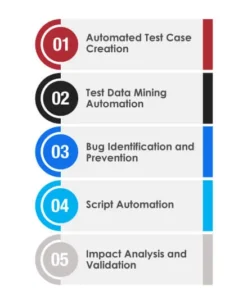
Automated Test Case Creation
One application of Gen-AI in SAP testing is automated test case generation for various business processes. This includes generating test cases for interfaces and connected systems. As the traditional test case generation process is error-prone and time-consuming, generative AI automates this process, creating comprehensive and accurate test cases much faster.
Test Data Mining Automation
Another application of generative AI for SAP testing is test data creation for multiple combination and process variants. Gen-AI creates realistic test data by mimicking real-world data or mining test data from SAP tablets. It ensures that SAP testing is conducted under varying conditions, processes, and data variants and maintains the highest coverage, enhanced productivity, and reduced cycle time. This is useful in complex testing scenarios where certain data sets are necessary to validate multiple SAP module functionalities.
Bug Identification and Prevention
The traditional testing approach misses minor bugs that become a big headache in the long run. Gen-AI resolves this issue by analyzing past data and incidents to predict possible bugs. This reduces the chances of post-deployment errors and improves the reliability of SAP systems.
Script Automation
After generative AI’s integration, the test script automation process experiences a significant impact. It amplifies the scope and effectiveness of test automation by creating test scripts for various testing scenarios and business processes and delivering consistent test results.
Impact Analysis and Validation
SAP systems undergo frequent updates, making it necessary to assess their impact during every modification. Gen-AI helps validate the accuracy and consistency post-upgrade. It ensures that new system updates do not affect existing functionalities and maintain integrity and performance.
Traditional SAP Testing Vs SAP Testing Using Gen-AI

| Aspects | Traditional SAP Testing | SAP Testing Using Gen-AI |
| Testing Process | Largely manual, requiring human effort for test case creation, execution, and analysis. | Automated processes, with AI generating and executing test cases and analyzing outcomes. |
| Test Data | Static, often requiring significant effort to create and maintain accurate, up-to-date test datasets. | Dynamic, with AI models generating synthetic test data that adapts to new scenarios and requirements. |
| Speed and Efficiency | Time-consuming due to manual tasks, with slower response to changes and updates in SAP applications. | Faster and more efficient, rapidly adapting to changes, and capable of running continuous testing. |
| Error Detection | Potentially less effective at catching complex or non-obvious bugs due to human error and limitations in test coverage. | Enhanced error detection through comprehensive analysis capabilities, identifying subtle and complex issues. |
| Cost | Technology costs will be lower initially but higher in the long term due to intensive labor and slower testing cycles. | Higher initial investment in AI technology, but likely to reduce costs over time through improved efficiency and fewer errors. |
| Scalability | Human resources limit scalability; increasing testing scope requires more personnel. | Highly scalable, as AI can handle large volumes of test scenarios and data without additional human resources. |
How Does AI Enhance SAP S/4HANA Testing?
SAP S/4HANA moves quickly, thus testing needs to move even more quickly. AI helps teams stay up by automating analysis, making test cases on demand, and checking setups across modules without slowing the project down. This basically implies that your change cycles will be more predictable, and there will be fewer surprises when you migrate or upgrade.
AI-driven models go through huge S/4HANA datasets, study how processes work, and warn of possible problems before they happen in production. This saves time by cutting down on repeated work and provides QA teams with more time to focus on important business situations.
Using Generative AI for Faster Results in Automated SAP Testing
Generative AI makes things go faster than it counts. It automatically produces test cases, scripts, and datasets, even for complicated processes like order-to-cash or procure-to-pay. Gen-AI makes test suites in minutes instead of days, so teams don’t have to spend days getting ready.
The benefits are shorter testing cycles, faster UAT, quick validation after updates, and quick SAP performance testing across all modules. For businesses who want to speed up their digital projects, this makes testing a growth enabler instead of a bottleneck.
Adding AI-Powered Test Automation to ERP Systems
There are a lot of dependencies in ERP systems. A slight change in finances or inventory might have a big effect on procurement, billing, or reporting. AI deals with this complexity by mapping interactions between modules, finding areas of influence, and automatically making relevant tests.
Let’s take it apart— AI-driven automation makes ERP environments stable by:
• Keeping track of changes in processes
• Automatically creating regression suites
• Finding problematic configurations
• Making sure that all modules are consistent with each other
This establishes a circle of quality that goes on and on across the whole SAP environment. If you need support implementing AI-driven SAP testing, integrating predictive analytics, or automating S/4HANA workflows, TestingXperts can partner with your team end-to-end. Schedule a quick call and get a clear, actionable plan.
Using Predictive Analytics in SAP Performance Testing
With predictive analytics, SAP performance testing goes from being reactive to being proactive. AI looks at patterns, system behavior, peak traffic cycles, and historical occurrences to guess where bottlenecks are most likely to happen, instead of waiting for problems to show up under stress.
This helps teams:
- Figure out how much memory, CPU, or database space they will need in the future
- Spot inefficiencies in memory, CPU, or databases early
- Lower the risk of downtime during upgrades
- Predict system slowdowns during peak months
It’s a better, data-driven way to keep SAP systems running smoothly and efficiently.
Business Benefits of Integrating Gen-AI into SAP Testing
Using Gen-AI for SAP testing offers various business benefits, optimizing enterprises’ approach to SAP system functionalities and efficiency. It brings a shift in testing methodologies, offering significant improvements in various areas:
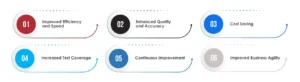
Improved Efficiency and Speed
Gen-AI tools substantially increase the efficiency of SAP testing. They automate the creation of test cases and scripts, thus reducing the time needed for test preparation. This results in faster testing cycles, enabling enterprises to implement SAP updates more quickly and keep pace with changing market trends.
Enhanced Quality and Accuracy
It analyzes large data sets and predicts results faster, contributing to higher SAP testing accuracy. It identifies the minor bugs and defects that go unnoticed in manual testing to ensure the superior quality of SAP applications. This, in turn, reduces error risk in live environments, assuring the stability and reliability of SAP systems.
Cost Saving
By automating repetitive or routine tasks, enterprises can reduce the cost, hours, and manpower required during manual testing. Early bug and issue detection also lowers the costs associated with post-deployment maintenance and fixes. It results in long-term financial benefits.
Increased Test Coverage
It can simulate various scenarios and impossible conditions in manual testing. This, in turn, expands the test coverage area to ensure a complete assessment of SAP systems, including complex functionalities. Businesses can be confident that their SAP systems are thoroughly tested under varying conditions.
Continuous Improvement
Gen-AI supports continuous improvement in SAP testing by quickly adapting to changes and providing ongoing feedback. This level of adaptability is vital for enterprises who want to optimize their SAP systems regularly. Continuous testing and feedback loop are crucial for enhancing SAP functionalities.
Improved Business Agility
Gen-AI enables faster and more effective testing processes to facilitate overall business agility. Businesses can adapt to market changes swiftly, fulfill regulatory requirements whenever they are updated, and facilitate business innovations. This helps in maintaining a competitive edge in today’s digital business environment.
Summary
SAP testing is necessary for enterprise applications to ensure the SAP system’s integration and reliability with various business operations. Gen-AI models like GPT-3 help automate QA tasks and boost efficiency, which is necessary for SAP systems. Key aspects of SAP testing include confirming module reliability, ensuring seamless integration with business applications, performance during peak hours, and proper security. Partnering with a reliable QA services provider like Tx would ensure that integration of gen-AI with SAP testing aligns with your business, which is necessary in today’s digital business world.
Why Partner with Tx for SAP Testing Services?
Tx offers a comprehensive suite of SAP testing solutions to ensure your SAP ecosystem operates seamlessly. Our team has deep expertise in gen-AI and SAP systems. We offer E2E testing, covering functional validation, performance optimization, security fortification, and user acceptance testing. Partnering with Tx will give you the following benefits:
• Our experts have in-depth knowledge of S/4 HANA and conduct rigorous testing to verify its performance, data integrity, and smooth integration with other systems.
• We incorporate gen-AI technologies in SAP testing to facilitate automated test case creation, predictive error analysis, and AI-driven performance optimization.
• We conduct E2E testing of SAP business modules to identify potential bottlenecks, optimize workflows, and enable smooth operations across the SAP landscape.
• By integrating gen-AI in SAP testing, Tx reduces the time and cost associated with manual testing processes. This leads to faster time to market and reduced business operational costs.
• We specialize in testing SAP BI and Big Data solutions to validate data accuracy, performance, and compliance with business requirements.
• We offer E2E testing for SAP Hybris solutions to ensure scalability, compatibility, and reliability across different devices and browsers.
To know more, contact our QA experts now.

VP, AI & QE Transformation
Michael Giacometti is the Vice President of AI and QE Transformation at TestingXperts. With extensive experience in AI-driven quality engineering and partnerships, he leads strategic initiatives that help enterprises enhance software quality and automation. Before joining TestingXperts, Michael held leadership roles in partnerships, AI, and digital assurance, driving innovation and business transformation at organizations like Applause, Qualitest, Cognizant, and Capgemini.
FAQs
How does Generative AI improve SAP testing efficiency?
It reduces human work by automatically creating test cases, data, and scripts. This makes it possible to run tests faster and cover more SAP modules.
What is the SAP testing process?
SAP testing ensures that SAP applications (like S/4HANA) function correctly after implementation, upgrade, or customization. It covers unit, integration, regression, UAT, and performance testing to validate business workflows end-to-end.
How Gen AI can change SAP S/4HANA Testing and QA?
Gen AI can:
- Auto-generate test cases from business processes.
- Enable self-healing automation scripts.
- Predict defect-prone areas.
- Speed up regression testing with intelligent test selection.
- Provide natural language test design and reporting.
How secure is AI-powered SAP testing?
AI-powered technologies work in controlled settings. When set up correctly, they follow the same rules for security, access, and compliance as regular SAP testing tools
What are the ROI benefits of AI in SAP testing?
Teams have shorter test cycles, fewer problems after going live, less manual work, and faster validation throughout upgrades, all of which lead to big long-term savings.
How does AI testing scale with SAP S/4HANA?
AI works well with S/4HANA’s fast update cycles because it can automatically create new tests, look at how changes affect things, and facilitate large-scale continuous testing.
Discover more