

Recommended Blogs

Post
Quality Engineering for Generative AI: Building Trust and Reliability at Enterprise Scale
Table of Content
- Why are Generative AI Applications Hard to Test?
- Top Challenges in Testing Generative AI Applications
- How to Test Generative AI Applications?
- Best Practices for Testing Generative AI Models
- How Does TestingXperts Ensure Robustness in Your GenAI Apps?
- Conclusion
Share On


Since the launch of OpenAI’s ChatGPT in 2022, which was the iPhone moment in the technology world, GenAI has transitioned from the experimental stage to an essential architecture. It is now supporting software development, workflow management, and decision-making. Generative AI applications are now creating content, managing data sources, making business decisions, and helping humans focus on creative tasks.
However, with greater innovation comes greater complexities. In the software context, GenAI apps are built using complex datasets and predictive models, presenting challenges in terms of quality, accuracy, and consistency. That’s where Generative AI testing helps overcome challenges that traditional QA methods can’t address.
Why are Generative AI Applications Hard to Test?
Unlike general software systems, GenAI apps are built slightly differently. This is because of AI algorithms, LLMs, vector databases, and prompt engineering. Normal software operates according to predefined rules, while GenAI apps deliver outputs based on unpredictable, large datasets. This creates complexities around test cases’ scalability, repeatability, and validation.
GenAI quality assurance challenges come from the non-deterministic nature of the outputs generated by Generative AI applications. Main testing challenges include:
- Identifying and resolving model biases
- Ensuring the model response aligns with business requirements
- Preventing AI hallucinations, securing data, and stopping attacks
- Maintaining performance and scalability in model computational power
Top Challenges in Testing Generative AI Applications
Implementing quality engineering across GenAI app development involves a web of interconnected testing challenges that are harder to address with a traditional QA approach. This covers technical complexities, ethical concerns, operational efficiencies, and quality assessment. Let’s take a closer look at the core challenges in testing Generative AI models:
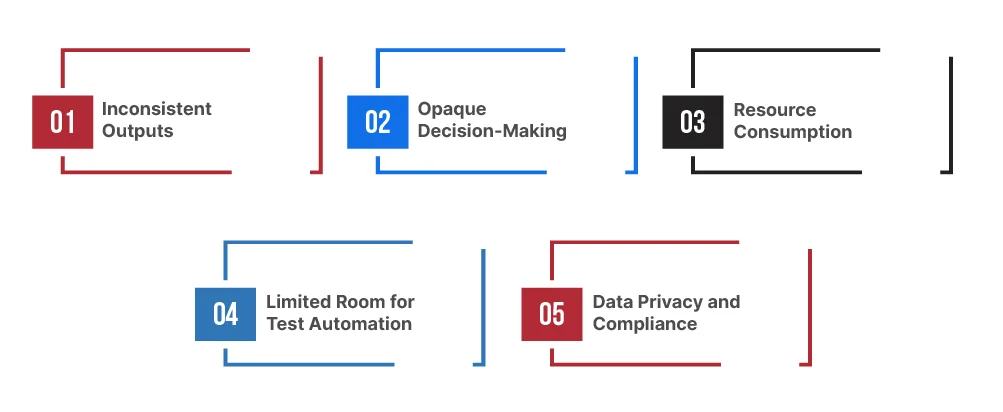
Inconsistent Outputs:
GenAI systems produce non-deterministic outputs, meaning the same input can yield different outputs. They can differ in length, tone, style, or structure, while still being correct. The traditional test automation approach will be ineffective here, and teams must shift to evaluation frameworks that assess quality rather than exact matches.
Opaque Decision-Making:
GenAI models are driven by neural networks that work on billions of parameters. Unlike traditional software, the decision-making logic of GenAI apps is not easy to explain or trace. This complicates defect diagnosis, root-cause analysis, and bias detection.
Resource Consumption:
Testing GenAI applications is expensive as each test execution drains significant GPU resources, memory, and bandwidth. Running regression and performance test cases can become costly, which an enterprise can address through test prioritization, smart sampling, and strategic testing methodologies.
Limited Room for Test Automation:
Generative AI app testing requires human judgment to assess attributes such as tone, context accuracy, usefulness, and creativity. Although test automation can validate syntax, security parameters, and performance thresholds, it cannot completely replace human involvement. One must use a human-in-the-loop model to implement effective quality engineering practices.
Data Privacy and Compliance:
Test Generative AI models for data leaks during training. This includes personal data, regulated content, and confidential BI. Additionally, evolving regulations require validation of data privacy controls, bias mitigation, transparency, and safety safeguards. Compliance testing is now a critical component of GenAI quality assurance.
How to Test Generative AI Applications?
To test GenAI applications, enterprises must think outside the box, as traditional methodologies will not work here. Take a look at the key steps involved in testing these systems:
Test for Output Consistency and Accuracy:
It’s true that GenAI Apps do not generate consistent output. However, you can compare multiple outputs for accuracy and consistency by using observability principles. Test generative AI models against criteria such as validity and usefulness, and use metrics like coherence, model behavior, relevance, and factual correctness.
AI Ethical Testing:
AI ethics has been in the news for quite a while. You need to test your AI models for biases and counterfeit outputs. Conduct fairness audits and bias testing across demographic groups to ensure your GenAI models produce fair and ethical results.
Assess Model Behavior:
There are always some variations in the AI model outputs, which is why you must assess your model behavior by injecting different inputs. Run stress tests to assess GenAI’s model knowledge base and capabilities.
Best Practices for Testing Generative AI Models
- Set up a feedback loop to monitor quality and model behavior, ensuring they remain aligned with your business objectives. As the model grows, so should your test strategy.
- Conduct AI governance testing to closely monitor whether your model adheres to the international and regional AI regulations (EU AI Act, California AI Regulations, etc.).
- Clearly define the output of your GenAI models, including their relevance to the actual result, potential ethical issues, and performance metrics. This will help ensure your AI model is always optimized for real-world applications.
- Test for ethical compatibility by identifying and resolving bias or discrimination bugs. This would allow you to operate your AI models in accordance with ethical guidelines, avoiding any repercussions.
- Test for edge cases to ensure your GenAI models remain robust and unaffected by input variations in real-world conditions.
- Generate industry-specific synthetic test data and use accurate system prompts to evaluate multiple key performance indicators.
How Does TestingXperts Ensure Robustness in Your GenAI Apps?
TestingXperts, one of the leading providers of Generative AI application testing services, helps enterprises unlock the true potential of GenAI apps. We help design, develop, and launch high-quality AI models with our quality engineering for AI solutions. Our QE for AI models helps you achieve:
- 80% improved response consistency
- 90% easy integration with CI/CD
- 80% faster model response times
- 50% reduced manual effort
Do you want to bridge the AI quality gap with industry-leading quality engineering solutions? Contact our AI solution experts now. We will assist you in leading the way in AI quality engineering with AI-based frameworks and years of industry experience.
Conclusion
Your current QA approach will fail with generative AI applications. Correctness is no longer binary, and risk is no longer linked to code. Because Generative AI results can vary even with the same inputs, enterprises must validate their model’s behavior, governance, functionality, and cybersecurity measures. You must treat quality engineering for AI as a strategy to accelerate GenAI adoption, combining observability, performance, ethics, and human judgment. To know how TestingXperts can help you tackle QE challenges, contact our GenAI experts now.


Anuj Kumar
Sr Test Manager
With 10 years of experience in automation development and testing, He has led the creation of innovative solutions that enhance software delivery and product quality. Skilled in UiPath, Katalon, Selenium, and Appium, with a strong focus on CI/CD. Extensive expertise in RPA, including custom UiPath solutions like screenshot comparison libraries and advanced drag-and-drop simulations, tailored to complex project needs.
FAQs
Why is quality engineering critical for building trust in generative AI applications?
Quality engineering ensures accuracy, reliability, and ethical behavior in generative AI outputs. Since GenAI is non-deterministic, enterprises must validate consistency, fairness, and security. This builds user confidence, reduces risks, and enables responsible adoption at scale across critical business functions.
What are the core pillars of a quality engineering strategy for GenAI at enterprise scale?
The core pillars include continuous validation, AI observability, ethical and bias testing, performance monitoring, data governance, and human-in-the-loop evaluation. Together, these ensure scalability, transparency, regulatory alignment, and consistent model behavior across dynamic enterprise environments.
How does TestingXperts deliver quality engineering for generative AI to ensure enterprise-grade reliability?
TestingXperts combines AI testing frameworks, domain expertise, and automation to validate accuracy, fairness, and scalability. Their approach integrates observability, governance, synthetic data testing, and CI/CD pipelines, helping enterprises reduce risks while accelerating secure and reliable GenAI adoption.
What are the most common quality engineering challenges in generative AI applications?
Common challenges include non-deterministic outputs, model hallucinations, bias risks, data privacy concerns, high compute costs, and limited automation. Enterprises also struggle with explainability, regulatory compliance, and validating contextual accuracy, which makes traditional QA approaches insufficient for GenAI systems.
Discover more