The banking industry has come a long way in terms of technological advancements, driven by the shift in customer experiences and integration of AI solutions. Traditional banking methods are getting replaced by modern digital banking and fintech startups, facilitating speed, agility, and a customer-centric approach. However, the basic methodologies for maintaining quality service and timely delivery are still important, as well as the process for achieving them.
This is where modern quality engineering for digital banks and financial services comes into the picture. It involves using more intelligent and automated processes powered by AI to address advanced digital banking challenges. McKinsey says that AI’s share in the banking and finance industry will reach $1 trillion.
Modern Quality Engineering in Digital Banking
Generally, quality engineering in digital banking focuses on testing, validating, and adhering to regulatory standards. However, in the digital banking age, this approach needs to change, as sticking to yesterday’s methods is not a solution to today’s challenges. Modern quality engineering for banking applications is not just about catching bugs and resolving errors. It also introduces a new level of complexity:
Digital channels such as mobile apps, online transaction portals, and digital touchpoints require robust QE solutions to ensure seamless UX.
Fintech startups are introducing innovative banking products and services, forcing traditional banks to adapt.
Regulatory standards are constantly evolving to facilitate technological shifts and require banks to stay compliant.
What Types of Quality Challenges Digital Banks Are Facing?
The banking and financial industry is facing a range of quality challenges in order to balance innovation with security and reliability. They have to maintain high-performance, bug-free applications while delivering seamless CX and ensuring strong cybersecurity measures against fraud. Let’s look at some of the quality challenges that hamper digital banks’ operations:
Digital initiatives remain stagnant due to rigid legacy systems that are expensive to integrate/replace with cloud and AI-based solutions.
Apps are unable to maintain uptime due to rising user traffic, thus creating technical glitches and API failures.
Sophisticated cyberattacks like identity theft, phishing, and push payments targeting digital banking applications.
AI-enabled threats like voice cloning and deepfakes are making it difficult to standardize security systems.
Inconsistencies in personalized services, such as automated bots that fail to resolve basic user problems, create frustration among users.
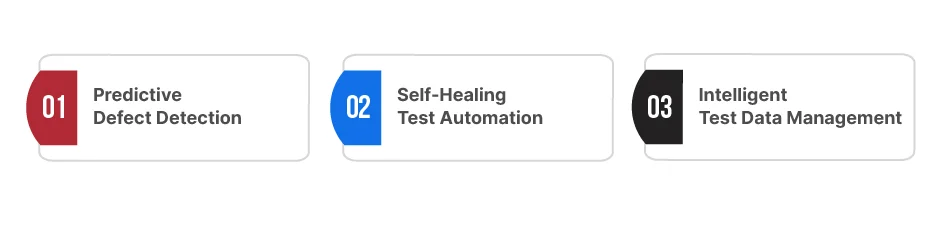
AI is augmenting human judgment and supporting testing teams by analyzing a large volume of data that a manual process alone cannot handle. In digital banking, testing teams are using AI to empower QE practices in several practical ways:
Predictive Defect Detection:
Traditional testing methods follow a reactive approach, detecting defects after they occur. Whereas AI analyzes historical data to identify defect trends and frequency complexity. It predicts where defects are most likely to occur and suggests which test methods are relevant. This shortens release cycles and also optimizes system stability.
Self-Healing Test Automation:
The digital banking industry is constantly evolving with UI upgrades, API version shifts, and integrations leading the charge. However, these changes often break scripts, creating maintenance overhead. Self-healing test automation uses AI to detect application updates and update the automation script accordingly. It reduces false failures and maintains the authenticity of regression suites as the system evolves.
Intelligent Test Data Management:
Test data is an important asset, as the QE team requires realistic data while ensuring customer privacy and regulatory compliance. AI generates synthetic test data that mirrors real data without exposing sensitive information. Teams can use this data to test edge cases, transactions, and fraud scenarios without relying on production data.
Building Scalable QE Strategy for Digital Banks
Maintaining quality in banking operations involves multiple processes, methodologies, systems, and tools. To build a scalable quality engineering strategy for the digital banking industry, you must connect every component (tests, deployments, dashboards, metrics) with outcomes, business risk, and compliance. The process involves the following components:
Test Automation Frameworks:
Automation helps verify the logic for real-time payments, AI-based credit scoring, and fund transfers. Every scenario is modeled, validated, and traced using test automation frameworks. Teams use tools such as:
Selenium
Cypress
Playwright
Postman
SoapUI
Tosca
UFT
CI/CD Pipelines:
Continuous integration and delivery act as guardrails to keep innovation risk-free. Every release is handled by a CI/CD pipeline that includes build validation, test suite automation, deployment readiness checks, and rollback strategy in case an issue is detected. Teams use tools such as:
Jenkins
GitLabs
Azure DevOps
Monitoring and Observability:
Banking apps are one of the critical products that require continuous monitoring and support. With observability in place, teams can spot slowdowns, API delays, and customer journey bottlenecks before they become critical. Teams such several tools like:
Dynatrace
New Relic
Splunk
Heatmaps
RudderStack
Test Data Management:
You must test what matters the most to ensure the effectiveness of QE practices in digital banking operations. Teams use synthetic data to cover fraud scenarios, implement edge cases, and analyze peak traffic.
Why Select TestingXperts for Modern Quality Engineering Solutions?
Organizations that deal in digital banking applications are implementing AI-driven solutions to transform their processes into measurable success factors. However, to ensure continuous testing and validation at every stage, you must adopt quality engineering, a shift-left testing approach. Partnering with TestingXperts for modern quality engineering services can ensure your banking products fulfill the highest quality standards and offer faster go-to-market. Our AI-driven QE for digital banking success delivers:
Digital banking is constantly evolving, and the complexities of application development and deployment will continue to increase. However, by adopting AI-driven quality engineering solutions from TestingXperts, you can optimize test coverage, efficiency, and accuracy while overcoming application development complexities through strategic QE planning and implementation. Our modern QE solutions offer a proactive testing approach that’s built into every release, across every channel, and through every integration. To know how we can help, contact our quality engineering experts now.
Bharath Babu is an Associate Director at TestingXperts with specialized expertise in core banking transformation, program and project management, and banking, financial services, and insurance (BFS) practice. He has a strong focus on digital banking and payments, driving strategic initiatives and delivery excellence in complex technology engagements across financial services.
FAQs
What are the latest trends in digital banking?
AI, cloud-native platforms, and customer-centric innovation drive the latest trends in digital banking. Key trends include:
AI-first banking
Embedded finance
Open Banking & API ecosystems
Cloud-native core banking
Security-by-design
What are the benefits of AI-enabled Quality Engineering for banking?
AI-enabled Quality Engineering transforms traditional testing into an intelligent, predictive, and autonomous quality model. Key benefits include:
Faster release cycles
Early defect detection
Reduced testing costs
Improved customer experience
Continuous quality validation
How can digital banks ensure zero-impact releases using AI-enabled QE practices?
Digital banks can achieve near-zero-impact releases by embedding AI-enabled QE by TestingXperts across the DevOps pipeline:
Shift-left testing
Predictive impact analysis
Continuous regression testing
Production monitoring feedback loops
Canary and blue-green validation
Can AI-powered QE help reduce production outages and downtime in banking apps?
Yes, TestingXperts AI-powered QE solutions significantly reduce production outages by enabling proactive quality assurance. Our expertise covers:
Anomaly detection
Root cause analysis (RCA)
Intelligent test coverage mapping
Chaos and resilience testing
Real-time observability integration
How does modern QE support regulatory compliance like GDPR, KYC, and AML?
Modern QE plays a critical role in ensuring compliance with regulations such as GDPR, KYC, and AML by embedding compliance validation into testing processes:
Data privacy testing
Cybersecurity and penetration testing
Audit-ready test evidence
Continuous compliance validation
Automated controls testing
Why should digital banks partner with TestingXperts for Quality Engineering?
TestingXperts deep domain expertise, AI-led QE capabilities, and proven accelerators help you achieve:
AI-driven QE frameworks
End-to-end testing coverage
Regulatory and cybersecurity expertise
Accelerated time-to-market
Proven banking & finance experience
What best practices ensure end-to-end testing coverage across digital banking user journeys?
To ensure comprehensive end-to-end testing coverage, digital banks should follow these best practices: