For modern enterprises, the traditional app support model comprising a tiered, hierarchical system is no longer sufficient. The issue is that the traditional support system is a reactive process and is increasingly expensive. The user discovers an issue, then they flag it, and then you run a sprint to restore service. This causes application downtime, which is a significant concern in today’s AI-driven environment.
According to research, the average cost of unplanned IT downtime is $14,056 per minute. However, many outages can be prevented with stronger management and control tools. This is where AI and predictive analytics come into the picture. It uses past and real-time data to forecast risk before an incident becomes evident. If used well, you can transform your app support from incident response to outcome assurance.
Why App Support Must Become a Strategy in the Digital Era?
Mobile and web applications have become the primary point of contact for users. Whether handling a retail platform, an eCommerce application, or an internal ERP, their performance will define your business success. But treating app support as an afterthought would risk you falling behind your competitors and decreasing revenue. As a C-level executive, you will experience app issues more than a technical glitch. It will be:
Revenue and margin leakage
Erosion of customer trust
Operational drag
Governance and risk exposure
Modern applications are a combination of legacy systems, APIs, SaaS, microservices, and front-end frameworks. That’s why you need to change your app support strategy from ticket closure to business continuity and performance governance model.
How Does AI Predictive Analytics Transform App Support Services?
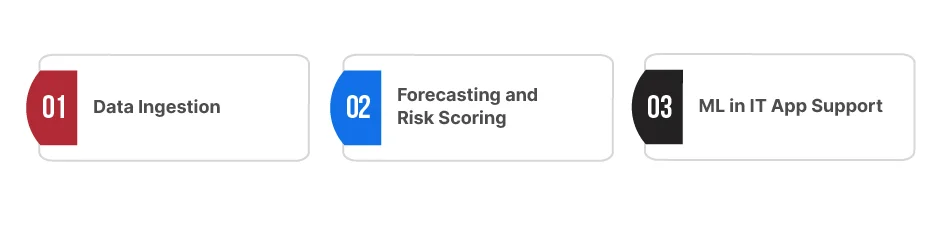
The core aspect here is data. AI-based predictive analytics leverages data to analyze patterns and indicate that the server might fail, or the application might crash within the next few hours. Here’s how it works:
Data Ingestion:
You feed logs, metrics, and traces into the machine learning model, which learn from your application behavior patterns. And when it detects a sudden deviation, it flags it as a risk.
Forecasting and Risk Scoring:
The AI predictive analytics app support shifts from “what happened” to “what will happen” process. It will give you clarity about:
The probability of a service breaching an SLO
Changes that may introduce outage risk
Components heading towards the saturation stage in the next few hours
Incidents that are likely to recur and why
ML in IT App Support:
Machine learning automates the root cause analysis in IT app support. Whenever an incident gets highlighted, AI can direct towards the code change or infrastructure shift that caused the anomaly. It reduces MTTD (Mean Time to Detect) and enables you to address the issue proactively.
Benefits of predictive analytics in enterprise application support
For enterprises, the shift to a proactive app support model offers measurable business ROI that extends across financial, operational, and customer-centric benefits. By identifying issues before they occur, you reduce the frequency of high-critical incidents.
Proactive app support with analytics enables you to schedule fixes during low-traffic periods, preventing the chaos of emergency patching.
Cost Reduction:
The role of predictive AI in reducing IT support costs for apps is substantial, as it helps you avoid recovering asset costs in the event of a total system failure.
Enhanced Customer Experience:
Leveraging machine learning for proactive mobile app maintenance ensures a seamless and bug-free experience for customer-facing platforms.
The Executive Blueprint to Operationalize Predictive Support
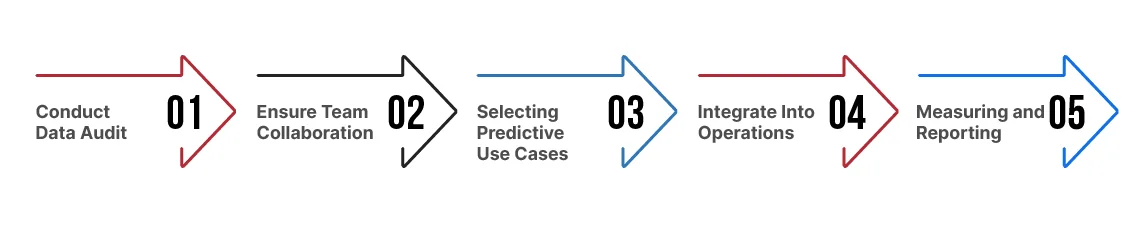
To successfully implement an AI-based predictive analytics strategy, simply purchasing a tool is not enough. You need to have a clear roadmap that must evolve as your processes and culture evolve. Implementing AI analytics for business-critical app support demands a structured approach.
Step 1: Conduct Data Audit:
Make sure you are collecting high-quality data from each layer of your application. The quality of AI-based predictions depends on it. Focus on predictive maintenance strategies with AI in software applications to prioritize critical assets first.
Step 2: Ensure Team Collaboration:
Your dev, QA, and operations departments must have a shared understanding of application health. They must be on the same page to move away from silos and towards a unified observability framework.
Step 3: Selecting Predictive Use Cases:
Prioritize use cases where it is easy to validate prediction quality, such as:
Change-risk scoring for high-quality releases
Capacity and saturation forecasting for infrastructure constraints
Incident likelihood forecasting for critical services
Step 4: Integrate Into Operations:
Integrate AI predictive analytics with modules that collectively handle the app support process. For example:
ITSM for ticket creation and routing
Observability tools for context and evidence
ChatOps for responder coordination
Runbooks for controlled remediation
Step 5: Measuring and Reporting:
Measure prediction accuracy and the time saved by the support team. Scale the solution across the entire enterprise and ensure you manage risks and device-level performance baselines effectively.
Why TestingXperts: AI Predictive Analytics for Digital Assurance at Enterprise Scale?
Predictive support is more than a data science issue. You need to ensure that the right data is collected, the right risks are predicted, and the right actions are taken. It’s a proactive measure that every business leader must implement in the AI-driven ecosystem. With AI transforming app support, you must protect your revenue, improve your customer experience, and empower your employees with new technologies.
At TestingXperts, we understand that digital assurance is the backbone of your enterprise ecosystem. Our AI-based predictive analytics approach emphasizes:
Leveraging Tx-Insights dashboards to manage performance risks, forecast trends, and application health.
Handle security alerts, performance dips, and more.
Testing predictive accuracy, false positive rates, and safe automation boundaries.
Improving observability coverage and data reliability to make actionable predictions.
Sourcing data from multiple channels and pre-processing it to ensure analysis in the right format.
App support becomes strategic when it reduces business risk, not just tickets. The economics of downtime and the preventability of many severe outages make a reactive posture difficult to justify. If you want a pragmatic starting point, focus on one Tier-1 journey, unify operational signals, and use AI predictive analytics to predict and prevent the next high-impact incident, rather than just responding to it. TestingXperts can help you assess readiness and prioritize the first predictive use cases based on your current tooling and incident history.
With 10 years of experience in automation development and testing, He has led the creation of innovative solutions that enhance software delivery and product quality. Skilled in UiPath, Katalon, Selenium, and Appium, with a strong focus on CI/CD. Extensive expertise in RPA, including custom UiPath solutions like screenshot comparison libraries and advanced drag-and-drop simulations, tailored to complex project needs.
FAQs
How secure is my data when using predictive analytics solutions?
Your data security depends on provider controls and your setup. Core safeguards include:
Encryption in transit and at rest
Role-based access
Network isolation
Audit logs
Data masking
Retention rules
Can predictive analytics integrate with my existing business software?
Yes. Integration usually uses APIs, database connectors, file exports, or event streams. Its common targets are:
CRM & ERP
Marketing tools
Support systems
BI platforms
Integration success depends on data access, identifiers, refresh needs, and change control.
How to leverage AI for predictive analytics and smarter decision-making?
To leverage AI for predictive analytics, follow the steps below:
Define the decision and measurable outcome
Collect relevant historical data
Build features
Train and validate a model
Deploy predictions into business workflows
Monitor drift and errors
Retrain on a schedule
What types of business problems can AI-powered predictive analytics solve?
AI-powered predictive analytics solve common business problems, like:
Demand forecasting
Churn risk
Lead scoring
Fraud detection
Inventory optimization
Pricing and revenue planning
Preventive maintenance
Credit and risk scoring
Customer segmentation
Anomaly detection in operations
What is AI in predictive analytics, and how is it different from traditional analytics?
Traditional analytics explains what happened and why. Predictive analytics estimates what is likely to happen next. AI models learn patterns from data to generate predictions, often handling more variables and non-linear relationships than basic statistical methods.
How accurate are AI-driven predictive analytics models?
Accuracy varies by data quality, problem stability, and how predictions are used. It must be measured on holdout data and monitored after deployment.
What are the biggest challenges when implementing AI in predictive analytics?
The biggest challenges that enterprises encounter when implementing AI in predictive analytics include: