

Recommended Blogs

Post
AI Agents and Hyperautomation: The Next Big Leap in Business Scaling
Table of Content
- Understanding AI Agents and Hyperautomation
- What is Hyperautomation?
- How AI Agents and Hyperautomation are Revolutionizing Business Scaling
- How Are AI Agents Transforming Testing, DevOps, and Operations?
- Intelligent Workflow Orchestration and Predictive QA
- AI for Continuous Monitoring and Decision Making
- Enterprise Scalability and ROI Assessment
- Industries Leading the AI & Hyperautomation Revolution
- The Future of AI Agents and Hyperautomation
- Conclusion
Share On


The future is automated: AI agents and hyperautomation are here to stay
70% of organizations will implement AI-driven automation in some form to scale operations efficiently, as per Gartner. This number marks a huge shift – enterprises failing to adopt AI agents and hyperautomation risk falling behind in an increasingly competitive landscape.
The business world is undergoing a complete transformation. Manual workflows and traditional automation are no longer enough to meet today’s fast-evolving market demands. AI agents and hyperautomation have emerged as the ultimate catalysts for scaling businesses, accelerating decision-making, reducing costs, and driving unmatched efficiency.
Hyperautomation, powered by AI agents, goes beyond basic automation by integrating robotic process automation (RPA), machine learning, and cognitive intelligence. It enables businesses to automate complex tasks that once needed human intervention, permitting them to scale at an extraordinary rate.
This is not a thing of the distant future – it’s happening now. Businesses that embrace AI-driven automation are enhancing customer experiences, streamlining operations, and unlocking new growth opportunities. The question is: Is your business updated and ready to scale, or are you lagging?
Understanding AI Agents and Hyperautomation
AI agents are autonomous, intelligent software entities capable of learning, adapting, and executing tasks without direct human intervention. Unlike traditional automation tools, they leverage natural language processing (NLP), predictive analytics, and cognitive computing to handle complex operations such as:
Customer interactions:
AI agents like ChatGPT or Google’s Bard provide highly personalized customer support without human involvement.
Fraud detection:
AI-powered agents in banking monitor transactions and detect anomalies in real-time, significantly reducing financial risks.
Supply chain optimization:
AI-driven bots predict demand, optimize logistics, and manage inventory dynamically.
What is Hyperautomation?
Hyperautomation extends beyond basic automation by integrating robotic process automation (RPA), machine learning, and cognitive intelligence to automate even the most intricate processes. Gartner defines hyperautomation as a business-driven approach that automates both IT and business operations at scale.
This approach empowers businesses to:
- Automate decision-making using AI models.
- Eliminate manual intervention in repetitive workflows.
- Enhance operational efficiency by seamlessly integrating AI agents into processes.
How AI Agents and Hyperautomation are Revolutionizing Business Scaling
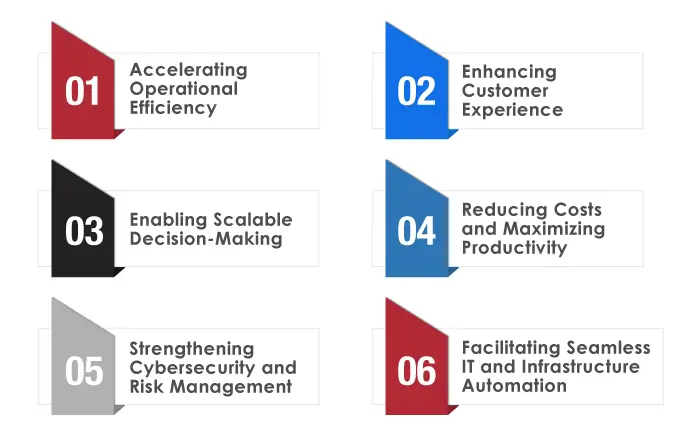
1. Accelerating Operational Efficiency
Hyperautomation eradicates bottlenecks by enabling AI agents to handle repetitive tasks, allowing human employees to pay attention to strategic initiatives.
For example:
- AI-driven RPA bots can manage payroll, process invoices, and update CRM systems in real time.
- AI agents can autonomously detect anomalies, data patterns, and make predictive decisions that check operational inefficiencies.
2. Enhancing Customer Experience
Customer expectations are at an all-time high. Businesses must provide seamless, real-time experiences to stay competitive.
AI agents and hyperautomation help by:
- Deploying conversational AI for 24/7 customer support.
- Using predictive analytics to anticipate customer needs and personalize interactions.
- Automating order processing, refunds, and service requests to enhance user satisfaction.
3. Enabling Scalable Decision-Making
AI-driven hyperautomation equips businesses with real-time insights and self-learning capabilities, enabling them to scale decision-making across departments.
For instance:
- AI-powered business intelligence tools can generate reports in seconds, allowing executives to make data-driven decisions.
- AI agents in financial institutions can detect fraudulent activities in transactions, reducing risks.
4. Reducing Costs and Maximizing Productivity
By integrating AI agents into hyperautomation workflows, businesses achieve cost reductions of up to 30-50%, as reported by McKinsey. This is due to:
- Lower operational costs by reducing reliance on human-intensive processes.
- Faster turnaround times, leading to higher output with fewer resources.
- Automated compliance tracking, reducing regulatory risks and fines.
5. Strengthening Cybersecurity and Risk Management
AI agents are playing a crucial role in cybersecurity by:
- Monitoring network activities in real time to detect and prevent cyber threats.
- Automating incident response protocols to mitigate security breaches.
- Leveraging AI-driven analytics to assess risks and vulnerabilities proactively.
6. Facilitating Seamless IT and Infrastructure Automation
AI-powered hyperautomation is streamlining IT management by:
- Automating software deployment, updates, and bug fixes.
- Self-healing AI agents that detect and resolve system errors before they cause downtime.
- Intelligent workload balancing for cloud computing and server optimization.
How Are AI Agents Transforming Testing, DevOps, and Operations?
AI agents for software delivery are speeding up release cycles and making them more reliable by automating complicated procedures between development and operations. key use cases include:
AI Agents For QA
Autonomous agents generate test cases, identify bugs, and rank risks based on their impact on the business. This gives people greater confidence in the release and reduces the manual work required.
AI Agents For DevOps
Agentic AI handles CI/CD orchestration, environment setup, and root-cause analysis. It reduces downtime and ensures delivery at scale, all the time.
AI Agents For IT Operations
These agents enable infrastructure to heal itself, detect problems, and respond to incidents automatically. This helps businesses get closer to running their operations in a way that is both predictive and robust.
Enterprise AI Agents In Governance and Compliance
They monitor rules, security concerns, and regulatory requirements in real time to ensure ongoing compliance.
This convergence of AI agents and hyperautomation is accelerating innovation and making operations more resilient.
Intelligent Workflow Orchestration and Predictive QA
Hyperautomation powered by AI enables intelligent management of complex operations across both business and IT platforms. AI agents analyze past and present data to identify problems, hazards, and system breakdowns before they occur.
Predictive QA employs agentic AI to find the most risky parts of apps and focus testing on those areas. This speeds up time to market and reduces the number of defects that get out. Autonomous AI agents also change their testing methods based on how users behave and how well the system works.
This change from reactive to predictive quality lets businesses make their products more stable and cut expenses at the same time.
AI for Continuous Monitoring and Decision Making
Enterprise AI agents give you constant visibility into apps, infrastructure, and the user experience. These systems gather information in real time and let you make decisions before they happen.
Key benefits include:
- Automatic checking of security, performance, and availability
- Finding and analyzing the root cause of problems in real time
- Smart notifications and automatic fixes
- Insights based on data that help executives make choices faster
Organizations can reduce downtime, make customers happier, and become more resilient by using AI-driven automation along with continuous monitoring.
Enterprise Scalability and ROI Assessment
A planned hyperautomation strategy helps businesses grow while still delivering measurable results.
Typical ROI drivers include:
- 30 to 50 percent cost reduction in operational processes
- Faster software delivery and improved release quality
- Enhanced productivity and resource utilization
- Reduced compliance risks and improved governance
Companies that use corporate hyperautomation also become more flexible and scalable, which lets them quickly meet market needs.
Businesses often struggle with complex implementations, integration issues, and governance. This is when strategic partners come in handy. TestingXperts helps companies create and grow AI-driven hyperautomation, ensuring that digital ecosystems are safe, reliable, and high-performing. They know a lot about AI agents for QA, DevOps, and IT operations, which helps speed up change with a clear return on investment.
Industries Leading the AI & Hyperautomation Revolution

1. Banking & Finance
- AI agents automate fraud detection, risk assessment, and customer service.
- Hyperautomation streamlines loan approvals, compliance checks, and financial forecasting.
2. Healthcare
- AI-driven automation is enhancing diagnostics, patient data management, and virtual health assistants.
- Predictive AI models help in disease detection and treatment planning.
3. Retail & E-Commerce
- AI agents personalize product recommendations and optimize supply chain logistics.
- Hyperautomation automates inventory management and order fulfillment.
4. Manufacturing
- AI-driven robotics improve production efficiency and predictive maintenance.
- Automated quality control systems reduce defects and enhance productivity.
The Future of AI Agents and Hyperautomation
The next phase of AI-driven hyperautomation will focus on:
- Self-learning AI agents capable of decision-making with minimal human intervention.
- AI-powered digital twins for real-time simulations of business operations.
- Decentralized AI automation for distributed and autonomous enterprise workflows.
- AI-powered low-code/no-code platforms enabling businesses to automate without extensive IT expertise.
- As AI and hyperautomation evolve, businesses will see unparalleled scalability, efficiency, and innovation.
Conclusion
AI agents and hyperautomation are no longer optional—they are business imperatives for scaling efficiently and staying competitive.
AI agents and hyperautomation aren’t futuristic concepts—they’re defining today’s business landscape. Organizations that embrace these technologies will lead the next era of efficiency, intelligence, and growth.
The future is here. It’s time to scale beyond limits.


Michael Giacometti
VP, AI & QE Transformation
Michael Giacometti is the Vice President of AI and QE Transformation at TestingXperts. With extensive experience in AI-driven quality engineering and partnerships, he leads strategic initiatives that help enterprises enhance software quality and automation. Before joining TestingXperts, Michael held leadership roles in partnerships, AI, and digital assurance, driving innovation and business transformation at organizations like Applause, Qualitest, Cognizant, and Capgemini.
FAQs
How do AI agents work?
AI agents analyze huge datasets, learn from patterns, and make decisions independently. They adapt to changing inputs, automate processes, and enhance industry efficiency. From customer support to healthcare, these intelligent systems simplify complex workflows, improving real-time accuracy and responsiveness.
What is the role of AI in Hyperautomation?
In hyperautomation, AI serves as the core intelligence, enabling machines to make complex decisions and automate intricate processes. This is done by analyzing large volumes of data, essentially replicating human cognitive functions to go beyond simple task automation and handle more nuanced workflows, including decision-making, pattern recognition, and real-time adjustments through features like NLP and computer vision.
Is Hyperautomation intelligent automation?
No, although intelligent automation is a key component of hyperautomation, they are not exactly the same thing. Hyperautomation is a broader strategy that aims to automate as many business processes as possible using various technologies, including intelligent automation (which combines AI and RPA). Meanwhile, intelligent automation focuses on specific tasks that require decision-making capabilities through AI and machine learning.
What is the difference between AI agent and automation?
An AI agent is capable of autonomous decision-making and learning, adapting to situations, and making choices based on real-time data. Meanwhile, automation strictly follows predefined rules for task execution and cannot adapt or learn independently. An AI agent is a more intelligent and flexible form of automation that can handle complex scenarios requiring real-time decision-making, whereas automation is best for repetitive, predictable tasks.
Discover more