

Recommended Blogs

AI Agent Evaluation: What Accuracy Alone Can’t Tell You
Table of Content
- Why AI Agent Evaluation Requires a New End-to-End Framework
- How AI Agent Evaluation Works Across the Lifecycle
- Top AI Agent Evaluation Metrics That Matter in Production
- Benchmarking AI Agents in Production Environments
- Designing AI Agents with Evaluation Built In
- How TestingXperts Helps You Build Trust in AI Agents at Scale
- Conclusion
Share On


When teams talk about evaluating AI agents, they often focus only on accuracy: was the answer right? It matters how accurate something is, but agent evaluation in production is more than that. An AI agent needs to be able to do tasks consistently, make good decisions in multi-turn interactions, use external tools correctly, and be safe, fast, and cost-effective. This blog post talks about an organized technique to test AI agents from start to finish so that you can test AI systems the way they truly work.
Why AI Agent Evaluation Requires a New End-to-End Framework
Traditional ML evaluation implies that the prediction will not change. Traditional software testing is based on deterministic logic. Modern agents are neither. Modern agents plan, act, and adjust their plans based on the tools, data, and context they have, as well as modifications to the model or trigger. That means even if your test suite stays the same, agents’ behavior can change.
In real life, a support agent answers a question about a refund accurately, but then uses a CRM tool with the wrong tool arguments (wrong customer ID), makes a wrong ticket, and never moves up. The text looks good, but the workflow doesn’t work. This is why accuracy alone isn’t enough to judge.
A comprehensive evaluation framework must score:
- Multi-step task completion and quality (not just “correct text”).
- Tool-use reliability (picking the correct tools, making valid api calls).
- Latency/cost trade-offs at a large scale.
- Safety, governance, and the ability to audit different versions of agents.
How AI Agent Evaluation Works Across the Lifecycle
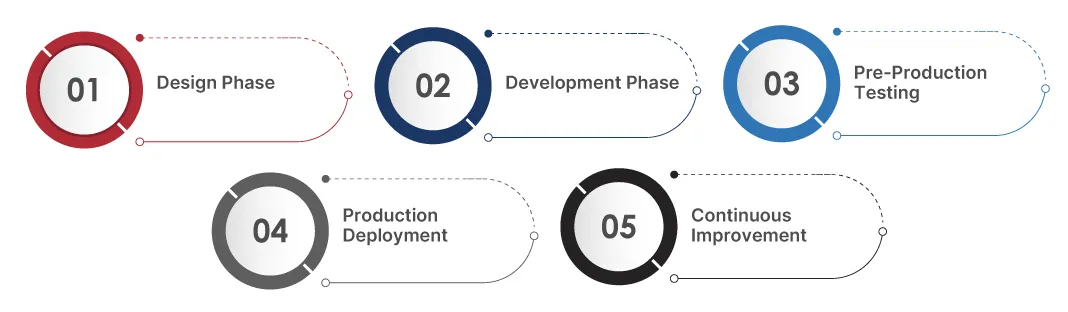
A long-lasting evaluation method contains five steps and uses both automated checks and human review for projects that are very risky.
Design Phase
Define success criteria before building:
- What the final output should look like after it’s “done.”
- Permitted operations and necessary tool calls.
- Escalation rules (when human oversight is mandatory).
- SLOs (latency/availability) and business metrics (conversion, deflection, CSAT).
Also, choose alternative evaluation methods based on risk level: tougher gates for money and health flows, and lighter samples for low-stakes tasks.
Development Phase
- Validate at component level first:
- Tool adapters (inputs/outputs, schema checks)
- Routing logic (when to call tools and when to answer directly)
- Policy filters and refusing to do something
Build trace capture for step-by-step traces so that failures can be debugged instead of being mysterious.
Pre-Production Testing
- Run tests in production-like conditions:
- Realistic workloads and multiple tasks at once
- Tool failures (timeouts, rate restrictions, old data)
- User input that is unclear and hostile
Production Deployment
Monitor agents continuously after deployment. An agent that passed staging might not work with real traffic. Use continuous monitoring to keep an eye on performance and spot problems early.
Continuous Improvement
Think of evaluation as something that happens all the time. Use the same evaluation dataset and live-traffic slices to compare different agent versions. This is an ongoing evaluation, which is the only sure way to stop quality drift from happening without anyone noticing.
Top AI Agent Evaluation Metrics That Matter in Production
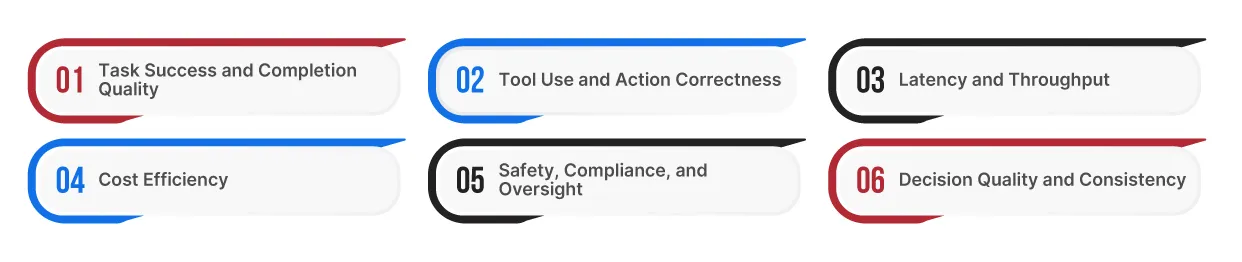
Keep track of these evaluation metrics as key metrics and put them all together on a dashboard as a limited collection of core metrics.
Task Success and Completion Quality
For each workflow, decide what success means and then give it a score:
- Task completion rate (did the agent finish the mission?).
- Checkpoints at the step level for partial credit (critical vs. non-critical stages).
- Comparison with the real world when it is available (tickets made, orders changed, data pulled).
This is extremely important for a multi-turn agent when success is a result, not a sentence.
Tool Use and Action Correctness
Agents often break down in tooling:
- Tool selection accuracy: expected tools vs actual tools used.
- Validity of arguments and how to handle responses.
- Retrying and recovering after failures.
- Safety of actions: permits, operations that can’t be undone, and triggers for escalation.
Keep an eye on the “wrong tool rate” closely. It’s a strong symptom of brittle routing or bad context.
Latency and Throughput
Measure end-to-end plus per-step performance:
- Average and tail latency (P95/P99).
- Latency of tools vs. latency of reasoning.
- Time wasted on trying repeatedly.
Cost Efficiency
Measure costs in a method that fits the business:
- Cost for each successful activity (better than cost for each request).
- Token use, tool fees, and infrastructure.
- Cost goes up when you try again or when you have a big multi-turn loop.
Safety, Compliance, and Oversight
For agents that deal with sensitive workflows:
- Policy violation rate and severity.
- Risk of managing and leaking PII.
- Keeping and completeness of the audit log.
Right escalation (did the agent call for a human in the loop when they needed to?).
Decision Quality and Consistency
A lot of failures are “good text, bad decision.” Keep track of:
Error rate on important steps in the decision-making process.
Consistency when tested repeatedly (variance/flakiness).
Drift over time (get back to where you were after updates).
The Minimum Viable Scorecard
A scorecard makes it easy to compare agents within and across teams over time. Here’s a clear example that you can change to fit your needs:
- Task completion: ≥ 92% (weighted 30%)
- Wrong tool rate: ≤ 2% (weighted 20%)
- Validity of the tool argument: ≥ 98% (weighted 10%)
- P95 end-to-end latency: < 2.0s (weighted 10%)
- Cost per successful task: ≤ $0.04 (weighted 10%)
- Safety/compliance violations: 0 critical, ≤ 0.5% minor (weighted 20%)
Add one custom metric that is related to your field, such as “policy adherence on refunds,” “PHI-safe responses,” or “contract clause correctness.” Scorecards also set release gates: if safety fails, the agent doesn’t ship.
Benchmarking AI Agents in Production Environments
Benchmarking needs to cover real-life situations:
- Workloads that are representative (not just chosen examples)
- Tool wear & tear and partial outages
- Measurement at scale (tail latency, uncommon errors)
Three layers should be used:
- Offline replay on test data or evaluation dataset
- Staging testing under pressure with added failures
- Business metrics linked to online checks (shadow mode, canary, A/B)
- LLM as a judge (helpful, but only with limits)
If you control it, an LLM as a judge can help with subjective outputs:
- Follow a stringent set of rules for what counts as excellent
- Keep a small set of labeled humans for checks.
- Check the agreement of the judges and revalidate it every so often.
- When you can, don’t test and judge using the same model family.
To avoid “grading the vibe,” pair judge scores with targeted human judgment checks of sampling outputs.
Designing AI Agents with Evaluation Built In
The best agents are made to be measurable from the start:
- Set evaluation thresholds at the time of requirements.
- Every action, tool response, and decision should be logged (traceable events).
- Conduct automated tests in CI/CD and stop releases if they fail.
- Keep evaluation hooks at both the component and end-to-end workflow levels.
If you utilize a model context protocol (or any structured context standard), make sure to test context assembly on purpose. Missing context typically leads to improper routing, wrong tools, and bad results, even when the model is good.
How TestingXperts Helps You Build Trust in AI Agents at Scale
TestingXperts helps companies set up strong evaluation procedures that do more than just check for accuracy:
- Set up success criteria and scorecards that are in line with production risk.
- Create test suites and regression harnesses that can be played again and again,
- Check that the tools are being used correctly, that API calls are being made, and that failure recovery strategies are being followed
- Set up continuous monitoring, release gates, and version comparisons.
- Add human reviewers where necessary for supervision
The result is evaluation results that can be repeated and checked, which means you can ship faster with fewer surprises.
Conclusion
There isn’t just one number for AI agent evaluation. To fully evaluate AI agents, you need to think about the whole process, including task success, tool accuracy, latency, and cost at scale, safety and compliance, and decision quality across different versions of the agent. Use a scorecard to make sure that measurements are consistent, compare them in settings that are similar to those in production, and keep evaluating them via monitoring. You can trust AI systems when evaluation is built in, not added on later.
Need a practical evaluation framework for your AI agents? TestingXperts can assess your current setup, define success criteria, build a scorecard, and implement automated tests + monitoring to keep quality stable across releases. Reach out to TestingXperts for an evaluation readiness review.


Michael Giacometti
VP, AI & QE Transformation
Michael Giacometti is the Vice President of AI and QE Transformation at TestingXperts. With extensive experience in AI-driven quality engineering and partnerships, he leads strategic initiatives that help enterprises enhance software quality and automation. Before joining TestingXperts, Michael held leadership roles in partnerships, AI, and digital assurance, driving innovation and business transformation at organizations like Applause, Qualitest, Cognizant, and Capgemini.
FAQs
What is the best tool for AI agent evaluation in regulated industries like finance and healthcare?
The top AI agent evaluation tools combine compliance checks, audit logs, and safety metrics with automated scoring. Look for platforms that support role-based governance, traceability, and risk reporting tailored to regulated workflows.
What AI agent evaluation services help organizations reduce production failures and quality drift?
Services that integrate continuous monitoring, regression testing, scorecards, and human review reduce failures and drift. They systematically track performance, tool use, latency, safety, and decision quality across versions.
Which AI agent evaluation framework works best for agentic RAG systems with retrieval tools?
A lifecycle framework that scores task success, retrieval accuracy, tool selection, latency, and cost works best for retrieval-augmented agents. It blends offline benchmarks with staging tests and live monitoring to surface brittle behavior.
What AI agent evaluation metrics should be included in an enterprise RFP?
Top AI agent evaluation metrics for RFPs
- Task completion and partial success checkpoints
- Tool selection accuracy and argument validity
- P95/P99 latency
- Cost per successful task
- Safety violations and escalation accuracy
Why do ai agent evaluation services help teams ship faster with fewer production incidents?
Because they build evaluation into the development cycle, enforce scorecards and release gates, and automate regression checks. This catches issues early and stabilizes quality, reducing rework and post-deployment incidents for TestingXperts company.
Discover more