Recommended Blogs

Enterprise Cloud Migration Strategy: A Step-by-Step Roadmap for Regulated Industries
Table of Content
- Why does Enterprise require a Cloud Migration Strategy?
- What are the Types of Enterprise Cloud Migration Strategies?
- Step-by-Step Enterprise Cloud Migration Roadmap
- What are the Enterprise Cloud Migration Best Practices Enterprises Must Know?
- How Can TestingXperts Assist With Enterprise Cloud Migration?
- Conclusion
Share On


Over the last decade, enterprises have been under constant pressure to modernize their infrastructure and support business agility. However, a cloud migration process without prior planning often leads to revenue overruns, performance issues, and security gaps. That’s why businesses require a well-defined cloud data migration strategy to ensure enterprise success in an AI-driven environment.
As per reports, the global public cloud services market will be valued at $1.7 trillion by 2029. As cloud migration requires thorough planning and execution, its roadmap should be aligned with the business and deliver measurable outcomes.
Why does Enterprise require a Cloud Migration Strategy?
A cloud migration strategy outlines the process enterprises need to move their data, infrastructure, workloads, and applications from legacy or on-premises systems to the cloud. They use a pubic, private, or hybrid cloud approach to initiate their migration project. However, a small migration mistake can have fatal financial and operational consequences. The advantage of a cloud migration strategy extends far beyond infrastructure savings, such as:
- Business disruption and downtime reduction
- Avoid resource sprawl and keep cloud operating costs under control
- The pay-as-you-go model minimizes IT overhead
- Improved operational performance through global networks and computing power
- Support digital transformation and innovation
If you don’t have a structured cloud migration strategy, your project will run on reactive operations rather than strategic ones.
What are the Types of Enterprise Cloud Migration Strategies?
Known as the 7 Rs, the cloud migration strategy follows these principles to migrate on-premises workloads to the cloud. The primary strategies include:
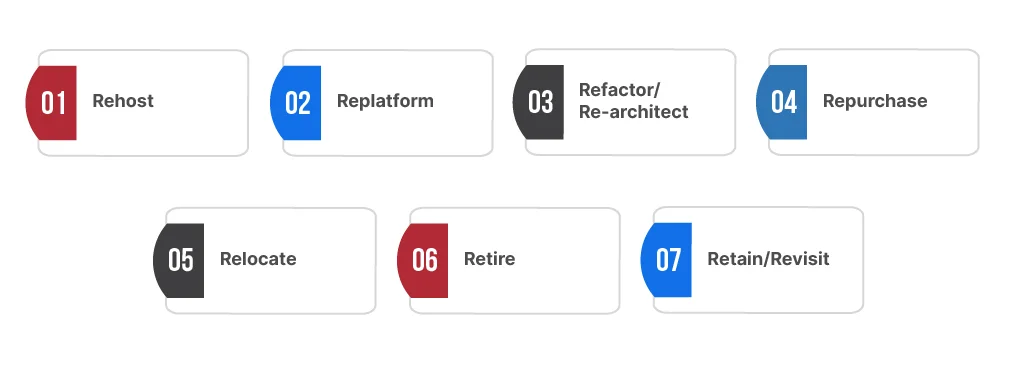
Rehost:
A lift and shift approach that involves migrating applications to the cloud without changing anything. It’s a fast and low-risk migration strategy with limited optimization and potential compliance gaps.
Replatform:
A lift and reshape strategy that involves making minor adjustments to the application to make it cloud-ready. However, it doesn’t alter the core architecture but offers optimized performance and cost efficiency with a moderate compliance gap.
Refactor/Re-architect:
It involves rebuilding applications from the ground up to make them cloud-specific, enabling maximum agility and scalability. This strategy offers strong security but with a higher cost and complexity.
Repurchase:
It’s a drop-and-shop strategy that involves moving the entire setup to a different platform, such as SaaS. This reduces operational workload and also requires vendor compliance validation.
Relocate:
A hypervisor-level lift and shift strategy that involves shifting entire infrastructure to the cloud without purchasing new hardware or recoding applications.
Retire:
This strategy helps identify and shut down IT assets that are not required in the cloud environment. This helps decompose obsolete applications and reduce operational risk and cost.
Retain/Revisit:
This strategy keeps applications on-premises for the time being until their regulatory or technical constraints are addressed.
Step-by-Step Enterprise Cloud Migration Roadmap
A successful cloud migration strategy should align with business objectives while accounting for the current IT landscape. At a higher level, your migration roadmap must follow the steps below:
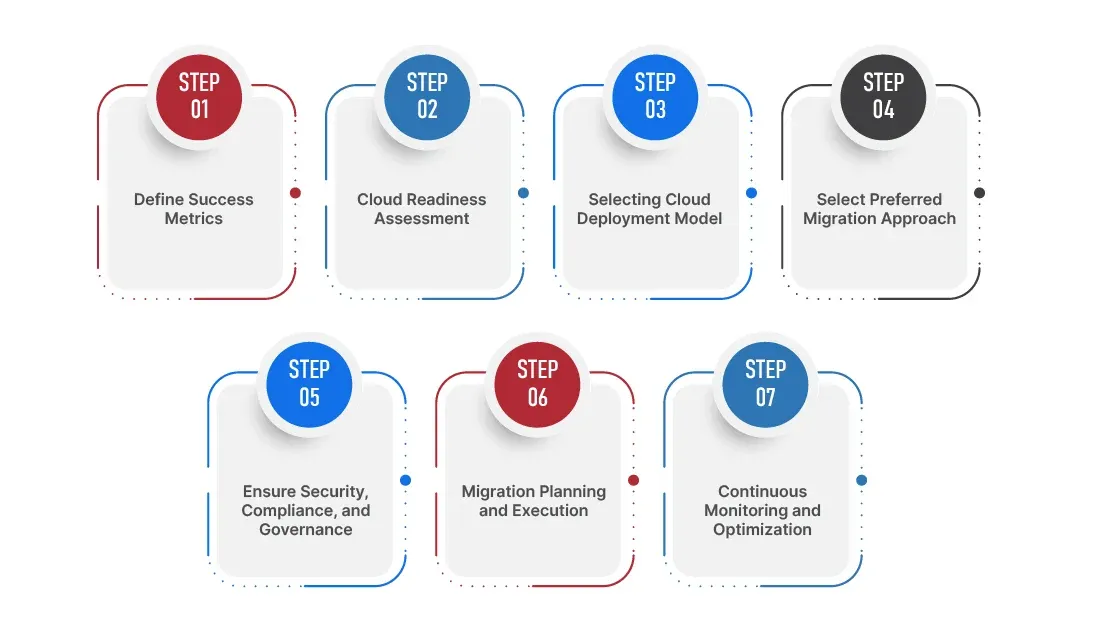
Step 1: Define Success Metrics
You must have clarity about your business objectives. Start by recognizing why you want to move to the cloud before deciding how to do so. The business objectives may cover infrastructure and data center costs, app scalability, security posture, and product development and deployment. Define your success metrics like:
- Cost savings
- Performance
- Uptime
- Deployment speed
Step 2: Cloud Readiness Assessment
Thoroughly assess your applications and enterprise workload to form the foundation of a cloud migration strategy. Start by evaluating data, dependencies, infrastructure, and applications to determine which components are cloud-ready and which require modernization.
Step 3: Selecting Cloud Deployment Model
Choose the cloud model that best suits your business objectives. Common models include public, private, hybrid, and multi-cloud environments. Usually, enterprises prefer multi-cloud or hybrid strategies to balance scalability and control.
Step 4: Select Preferred Migration Approach
Usually, businesses prefer to leverage multiple migration approaches to move their application portfolio. Common approaches include rehosting, refactoring, retiring, replatforming, and repurchasing. It is a core aspect of a successful migration strategy.
Step 5: Ensure Security, Compliance, and Governance
Ensure you embed security posture into your migration strategy, as compliance failures can be costly. Make sure to include the following security considerations:
- Data encryption and key management
- ISO, GDPR, HIPAA, and other compliance
- Cloud governance and policy enforcement
- Identity and access management (IAM)
- Continuous monitoring and threat detection
Step 6: Migration Planning and Execution
Execute your cloud migration strategy in controlled phases to reduce risks and build confidence among stakeholders. Best practices include validating performance and security, minimizing downtime, using automation tools, and piloting workloads.
Step 7: Continuous Monitoring and Optimization
Cloud migration doesn’t end when infrastructure is shifted from one platform to another. It requires continuous monitoring and optimization for long-term success. Your strategy must include post-migration fixes like cost optimization, usage monitoring, security management, modernization, performance tuning, and continuous improvement.
What are the Enterprise Cloud Migration Best Practices Enterprises Must Know?
A Cloud migration setup follows practices that minimize risks, prevent technical debt, and facilitate faster time-to-market. The following are some cloud migration best practices that enterprises like yours should know to maximize success:
- Build compliance into the migration pipeline
- Automate security and policy enforcement
- Maintain centralized visibility and monitoring
- Engage compliance and risk teams early
- Treat migration as a continuous improvement process
How Can TestingXperts Assist With Enterprise Cloud Migration?
Shifting to the cloud offers multiple benefits, including cost efficiency, scalability, and flexibility. However, issues related to data security, integration, performance, and privacy pose challenges for cloud migration. TestingXperts holistic cloud migration strategy ensures a seamless transition to the cloud by incorporating CI/CD and DevOps. Our cloud modernization and migration services help you achieve:
- 95%+ accuracy in cloud modernization and migration
- Up to 65% cost reduction in migration
- Successful multi-cloud migrations in Azure, AWS, and Google Cloud
Looking for a professional cloud migration service provider? Contact our cloud experts now to know how TestingXperts can assist.
Conclusion
For enterprises, cloud migration is not a simple IT initiative to shift components from one platform to another. A well-structured enterprise cloud migration strategy allows you to modernize securely and maintain regulatory trust. TestingXperts helps you define a strategy to test and scale to the cloud by addressing modernization challenges and pitfalls. Our end-to-end testing approach and SaaS expertise ensure you maintain high quality across all aspects of cloud migration. To know more about our cloud migration expertise, contact our cloud experts now.


Ashwani Narula
Associate Vice President Delivery
Experienced Director- Quality Assurance with a demonstrated history of working in the information technology and services industry. Skilled in Requirements Analysis, Agile Methodologies, Test Automation, Mobile Applications, and Test Management. Strong quality assurance professional with a Bachelor of Engineering - BE focused in Electrical, Electronics and Communications Engineering from Model Institute of Engineering and Technology.
FAQs
How to build an enterprise cloud migration strategy?
The following are the steps involved in building a cloud migration strategy at an enterprise level:
- Step 1: Define business goals
- Step 2: Assess applications and data
- Step 3: Select migration approaches for each workload
- Step 4: Design a secure cloud architecture
- Step 5: Establish governance
- Step 6: Plan phased execution with validation and optimization
What are the steps involved in enterprise cloud migration?
The following are the steps involved in the enterprise cloud migration journey:
- Step 1: Assess workloads
- Step 2: Classify data
- Step 3: Select migration strategies
- Step 4: Design target architecture
- Step 5: Establish governance and migrate in phases
- Step 6: Validate security and performance
What challenges do enterprises face during cloud migration?
During cloud migration, enterprises face several challenges, such as:
- Data security risks
- Compliance gaps
- Application dependencies
- Cost overruns
- Downtime during migration
- Lack of governance or visibility
How to create a cloud migration roadmap for enterprises?
To create a cloud migration roadmap, one must consider the following aspects:
- Inventory applications
- Map dependencies
- Prioritize workloads by risk and value
- Select migration strategies
- Define phases
- Set governance controls
- Include validation and optimization milestones
What are the best practices for an enterprise cloud migration strategy?
The best practices we at TestingXperts follow for a successful enterprise cloud migration strategy include:
- Assess early
- Migrate in phases
- Automate security controls
- Enforce governance
- Monitor costs and document for audits
- Continuously optimize performance and compliance
Discover more