Recommended Blogs

WCAG 2026 Compliance: Stay Ahead with Accessibility as a Business Asset

 Last Updated: January 27th, 2026
 Read Time: 2 minutes
Table of Content
- Why Must Your Business Strategy Include WCAG Compliance in 2026?
- The Modern WCAG Landscape: What 2026 Means for Enterprises
- Beyond Measures: Accessibility Compliance as a Growth Engine
- How to Implement Accessibility Across Your Enterprise Landscape?
- Why Partner with TestingXperts for WCAG Compliance Audit?
- Conclusion
Share On


Having an inclusive website design has become a necessity in today’s time if a business wants to remain legitimate and operational. In 2026, the way you make your services accessible to the people will help you reduce legal exposure and build brand trust. However, it has been observed that early-stage startups often overlook web accessibility and prioritize features over it. As a result, it blocks a considerable market share and leads to lost contracts or, in some regions, lawsuits.
With over 1.3 billion people (approx.) living with some kind of disability, websites that exclude this 16% of the global population are not just ethically wrong, but also financially doomed. That’s why standards like the Web Content Accessibility Guidelines (WCAG) offer recommendations for making website content more accessible and consumable.
Why Must Your Business Strategy Include WCAG Compliance in 2026?
In 2025, the number of web accessibility lawsuits in the US reached record heights of 4,605 federal filings. This was a 23% increase in such cases compared to 2024. Imagine the settlement amount for those cases, with average costs exceeding $50,000 for small to medium enterprises and millions for larger enterprises.
The W3C published the WCAG 2.2 in October 2023, and it is currently the latest version of the web accessibility standard. As the legal landscape continues to evolve, the ADA compliance is also one of the acts that will govern the website’s accessibility level. It explicitly states that state and local government entities must make their services WCAG 2.1 Level AA compliant; otherwise, they will face consequences. And the Title III cover entities, such as:
- Retailers and eCommerce sites
- Restaurants, hotels, and entertainment venues
- Healthcare providers and hospitals
- Financial institutions and insurance companies
- Professional service providers
- SaaS companies
- Business offering goods or services to the public
It doesn’t matter whether you are operating in the EU, the US, or any other regulated market; your web services should be WCAG-compliant and must be a part of your business strategy in 2026 and beyond. You must understand the strategic WCAG compliance framework and future-proof your organization.
The Modern WCAG Landscape: What 2026 Means for Enterprises
From accessibility checkboxes to revenue growth, WCAG compliance opens the door to a huge number of audiences, helps improve SEO rankings, and reduces support costs. As per research, inclusive design principles can improve usability by 30% for all users. Enterprises must recognize that the 2026 marketing landscape has shifted, adopting a more technical, operational, and compliance-driven approach. It will directly affect how a user perceives a digital experience in terms of readability, navigation, interaction, and conversion. For business leaders, the modern WCAG landscape and inclusivity in 2026 means:
- Users can access digital services regardless of their ability, device, or condition.
- Marketing technology and automation solutions support accessibility from the inside out.
- Building personalization frameworks with structured, readable, and ML-friendly content.
- AI models can accurately and ethically interpret user behavior without any hallucinations or biases.
- Avoiding legal fines and risks while building a brand reputation through ethical business practices.
Beyond Measures: Accessibility Compliance as a Growth Engine
Accessibility is at the core of business pillars that affect trust, conversion, and the performance of digital services. Users today require intuitive, frictionless, and legible interactions, rather than buggy and difficult-to-access navigation bars. Many users even uninstall the app if it crashes during the first run. WCAG 2.2 introduces several measures that directly affect enterprise lifecycle communication, demand-generation assets, digital purchase journey, and gated content.
These measures majorly impact visual clarity, user tasks, navigation, and form activity. WCAG 2.2 helps reduce accessibility friction for users with visual, cognitive, and motor limitations. It means the website:
- Forms must be easily accessible and easy to complete.
- Interactive components, such as buttons, sliders, and animations, must be predictable.
- Design components, such as color, font size, and style, must have clear visual focus indicators.
- Content should be understandable and accessible across all contexts.
Following accessibility compliance guidelines, such as ADA and WCAG, will ensure that enterprises meet every high-intent asset with recommended durability, consistency, and clarity standards. Moving beyond a checkbox mentality would help create an environment where every individual considers accessibility a shared responsibility.
Instead of merely passing audits, businesses should measure success through trust-centric KPIs, such as retention rates, revenue growth, and user satisfaction scores across markets. Using automated testing tools like WAVE and axe DevTools, businesses can collect feedback to ensure a seamless user experience.
How to Implement Accessibility Across Your Enterprise Landscape?
Creating websites and user portals is not a one-time activity, but rather a disciplined approach that is integrated across the design, development, content creation, and deployment stages. Implementing WCAG guidelines across your enterprise ecosystem would require a structured approach that will go through these stages:
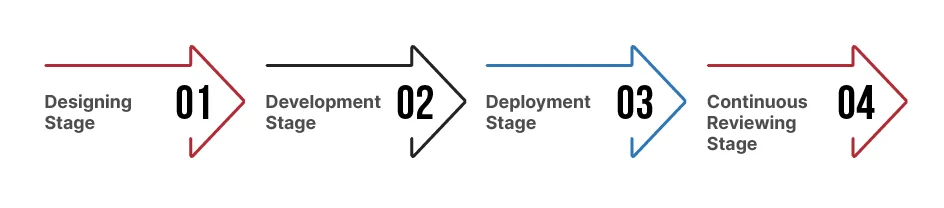
Designing Stage:
The key practices in this stage will include selecting color palettes that meet the WCAG contrast ratio of 4:5:1 and avoiding relying on color to convey meaning. You must use scalable font styles and include an adjustable text size functionality in your web application. Follow a proper page structure, using H1 to H6 headings and <nav>, <main>, and <footer> landmarks. Include alt text for images and captions/transcripts for video/audio content.
Why Partner with TestingXperts for WCAG Compliance Audit?
While it’s important to ensure accessibility, you need an expert QA service provider who can help you meet WCAG 2.2 standards and regulatory mandates. TestingXperts, a top accessibility testing services company, combines its advanced tools expertise with AI-driven solutions to identify gaps, ensure WCAG and ADA compliance, and enhance UX. Our solutions deliver:
- 80-90% Compliance with WCAG guidelines
- 75-90% Improvement in compatibility with assistive technologies
- 30–40% Savings in Development Costs
- 40-50% Enhanced accessibility market reach
If you also want to ensure an intuitive digital experience across your web application channels and create an accessible ecosystem for all users, contact our accessibility experts now.
Conclusion
In 2026, WCAG compliance is going to be your strategic asset that can drive customer retention, revenue growth, and a competitive advantage. By adopting WCAG 2.2 compliance across your web application channels and viewing it as a growth engine rather than a checkbox, you can unlock substantial business value and future-proof your enterprise. With the right strategies in place, enterprises can not only meet accessibility standards but also reap the rewards of a more inclusive digital presence. Partnering with experts like TestingXperts can ensure that your compliance efforts lead to real, measurable business outcomes.

VP, Delivery Quality Engineering
Manjeet Kumar, Vice President at TestingXperts, is a results-driven leader with 19 years of experience in Quality Engineering. Prior to TestingXperts, Manjeet worked with leading brands like HCL Technologies and BirlaSoft. He ensures clients receive best-in-class QA services by optimizing testing strategies, enhancing efficiency, and driving innovation. His passion for building high-performing teams and delivering value-driven solutions empowers businesses to achieve excellence in the evolving digital landscape.
FAQs
Why must WCAG compliance be part of a business strategy in 2026?
- Reduces exposure to accessibility lawsuits and related legal costs
- Strengthens brand trust and reputation through inclusive practices
- Improves conversion by reducing friction in navigation, forms, and interactions
- Expands your addressable audience across abilities, devices, and conditions
- Lowers support costs by improving usability and reducing user errors
How does WCAG compliance support business growth (not just compliance)?
- Improves usability for all users (inclusive design can improve usability by ~30%)
- Enhances readability, navigation, and task completion—supporting higher conversion
- Can improve SEO outcomes through better structure and content clarity
- Reduces friction in demand-gen assets, purchase journeys, and gated flows
- Supports ethical, accurate personalization and behavior interpretation (including AI/ML use cases)
Discover more