For any organization, data is the most critical asset if it wants to succeed in today’s digital ecosystem. It brings a lot of opportunities to accelerate investments in AI, cloud platforms, and analytics. However, many enterprises still rely on traditional data warehouse foundations, which carry measurable risks. As per report, poor data quality has cost businesses $12.9 million/year on average.
The reason? Inefficient warehousing is causing rework and missed opportunities. Leaders should know that data warehouse modernization is not just a mere IT issue. It will directly affect decision-making, growth, and governance.
What Is the Strategic Cost of Stalled Data Warehouse Modernization?
Data warehouse modernization delays create a large risk profile for enterprises. Leadership teams will operate with slower insight cycles, limited agility, and high dependency on manual workarounds. And when competitors shift to cloud-native or AI-enabled analytics, your organization is still stuck with legacy performance foundations.
As Traditional environments lack data lineage and audit trails, stalling cloud-based data warehouse modernization would weaken audit and governance readiness. And if you are a product or service-based organization, it will degrade your customer experience and user trust in your brand. Also, legacy platforms are costlier to run due to scaling limitations and maintenance overhead.
The Silent Warning Signs of Modernization Slowdown
The impact of the modernization slowdown is not visible to the naked eye. It slowly erodes business performance until its impact becomes unavoidable. Also, organizations struggling with fragmented data environments are more likely to lose customers due to poor data-driven experiences. Common early warning signs of modernization slowdown include:
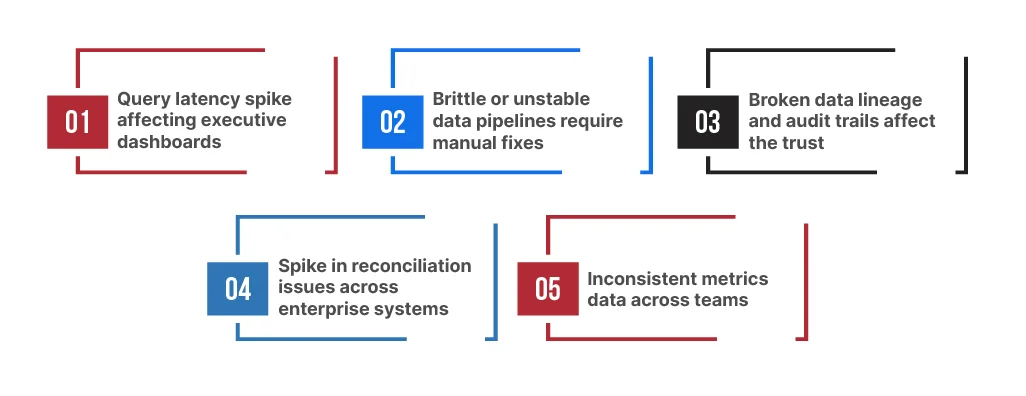
- Query latency spike affecting executive dashboards.
- Brittle or unstable data pipelines require manual fixes.
- Broken data lineage and audit trails affect the trust.
- Spike in reconciliation issues across enterprise systems.
- Inconsistent metrics data across teams.
Considering these symptoms in isolation will turn them into operational bottlenecks. As a result, it would affect planning cycles, audits, and customer-facing decisions.
Legacy ETL: The Hidden Anchor Pulling Modernization Back
Another primary reason for the delay in modernization is the enterprise’s dependency on outdated ETL foundations. These pipelines were meant for predictable, batch-driven operations. They were coupled to specific sources, transformation logic, and schedules. However, as technology advances and legacy systems fail to keep pace, documentation weakens, dependencies multiply, and even the slightest changes require double the effort. As a result, businesses feel constrained when onboarding data sources.
Additionally, the legacy ETL pipeline is not fully compatible with modern ETL processes (eg, event-driven ingestion and real-time data processing). Without proper ETL automation and adherence to ETL best practices, you will be forced to choose between trust and speed, thereby increasing operational risk and slowing down data warehouse modernization.
Architecture Gaps That Prevent True Modernization at Scale
The majority of modernization initiatives pause after the initial stage due to hidden architectural constraints. Migrating unstructured data to a new platform, as well as monolithic warehouse designs and rigid storage and transformation layers, restricts scalability and performance. Additionally, when new data sources are introduced, schema rigidity can cascade downstream failures, thereby increasing operational risk.
Siloed data models also weaken data warehouse modernization efforts. It makes enterprise-wide analytics unreliable. However, modern architectures address this by utilizing shared and governed data layers, as well as standardized integration patterns. Data lakehouse and distributed architectures also enable automated data transformation that legacy designs cannot provide.
How Do You Balance Speed and Quality in Data Warehouse Modernization?
Speed without trust introduces risk, whereas a successful approach balances acceleration with control through streamlined frameworks. The key enablers for data warehouse modernization include:
| Key Enablers |
What it Does |
Impact |
| Automation-Led ETL Best Practices |
Standardized ETL design, version control, and repeatable deployment via automation. |
Reduce human error, improve pipeline consistency, and enable faster changes. |
| Continuous Data Validation and Reconciliation |
Automated validation checks and reconciliation processes to detect mismatches early. |
Ensure data completeness and accuracy while preventing incorrect data from reaching downstream systems. |
| End-to-End Lineage Visibility |
Lineage tracking shows data movement, transformation, and aggregation across systems. |
Strengthens trust, supports audit and compliance needs, and simplifies impact analysis. |
| Data Governance in Modernization |
Governance frameworks are integrated into pipelines for access control, quality checks, and compliance policy. |
Ensures modernization progresses without any operational or regulatory risk. |
| Proactive Monitoring with Observability Tools |
Data observability platforms monitor the latest version, volume, and distribution patterns. |
Proactively alerts teams in the event of an anomaly detection. |
Why TestingXperts: Your Partner for Risk-Free Modernization
Data warehouse modernization fails when governance, quality, and performance are addressed too late. There are other factors as well, like security, process flow, and storage issues. TestingXperts, a leading ETL & Data warehouse modernization company, helps you overcome these factors by embedding assurance into every stage. Our ETL & data warehouse services enable modernization through:
- ETL automation and validation acceleration.
- Data reconciliation frameworks for legacy-to-cloud migration.
- Performance engineering for cloud-scale workloads.
- Cybersecurity and data security for warehouse validation.
- Continuous testing aligned with data integration best practices.
Are you also looking for ETL testing services for data warehouse modernization? Our approach enables faster modernization while maintaining confidence in data security, accuracy, and business continuity. We deliver measurable results:
- 95%+ Data Accuracy Rate
- 30% Reduced Data Storage Costs
- 50% Faster Data Integration
- 40% Improved Data Pipeline Performance
Conclusion
Stalled data warehouse modernization is a liability that affects competitiveness, compliance, and customer trust. Legacy ETL, rigid architectures, and manual controls quietly slow progress until risks become visible at the board level. You must treat modernization as a governed process, anchored in effective ETL strategies for data warehouse modernization, automation, and architectural redesign. With the right partner, such as TestingXperts, leaders can modernize with confidence, unlock real-time insights, and ensure their data platforms are built future ready.
VP, Delivery Quality Engineering
Manjeet Kumar, Vice President at TestingXperts, is a results-driven leader with 19 years of experience in Quality Engineering. Prior to TestingXperts, Manjeet worked with leading brands like HCL Technologies and BirlaSoft. He ensures clients receive best-in-class QA services by optimizing testing strategies, enhancing efficiency, and driving innovation. His passion for building high-performing teams and delivering value-driven solutions empowers businesses to achieve excellence in the evolving digital landscape.