

Recommended Blogs

Your Enterprise Application Performance Isn’t Scaling: Here’s Why
Table of Content
- The Strategic Cost of Non-Scalable Enterprise Application Performance
- The Early Indicators of Performance Breakdown Leaders Miss
- Where Performance Really Breaks: Architectural Weak Points
- Why Scaling Fails: Data, Workload, and Integration Bottlenecks
- Building Continuous Performance Intelligence for Scale
- Why TestingXperts for Enterprise App Performance Testing Services?
- Conclusion
Share On


The enterprise ecosystem has changed drastically since the AI-led digital transformation. It’s restructuring how you operate, compete, and scale with technology. Core enterprise applications like CRM, SCM, HRMS, ERP, and BI now support real-time AI-driven decisions, automation, and data-intensive workloads. However, do you think there won’t be any issues? Recently, enterprise application performance has become a major concern for business leaders.
According to research, application latency directly impacts user engagement, and if there are delays, the result would be abandonment and degraded trust. If your app fails to scale, it can expose your performance bottlenecks identification challenges, affecting CX and revenue.
The Strategic Cost of Non-Scalable Enterprise Application Performance
One of the common mistakes enterprises make is considering performance limitations as an isolated technical glitch. And when this glitch becomes a strategic liability, they will never see it coming. If your app performance is not up to mark, your business will experience:
- Slow-paced digital initiatives and AI use cases rollout
- A degraded customer experience causing revenue leakage
- Cloud infrastructure costs not aligning with business value
- Over-the-charts operational risks during peak hours
These issues may sound minimal, but the cost associated with them compounds over time. For example, infrastructure overprovisioning or reactive performance testing can increase costs. On top of that, if volumes, data flows, and integrations expand, underlying performance bottlenecks will multiply further and will be harder to locate.
The Early Indicators of Performance Breakdown Leaders Miss
Issues never appear overnight. They were in the code all along, but were dismissed as irrelevant. The same is true for scalability failures. These are micro-frictions that are easy to ignore until they become systemic. Here is how to identify performance bottlenecks in enterprise applications:
- Drastic change in latency during business hours
- API performance bottlenecks affecting downstream services
- UX delays between request and system response
- Application crashes at unpredictable times
- Drop in CSAT and NPS ratings
- Consistent increase in resource consumption
- High database waits hampering application performance
- Low recovery rates during garbage collection
- Increased MTTR and change failure rate
These enterprise application architectural stress factors cannot be handled by traditional monitoring alone. Without combining application performance monitoring (APM) with tracing and profiling, you will lack visibility into bottlenecks. That’s why you need proactive application profiling tools and root cause analysis.
Where Performance Really Breaks: Architectural Weak Points
Application performance breaks inside architectural decisions that once supported scalability. Now these decisions are not suitable for today’s scale, AI-driven workloads, and integration density. A monolithic code structure also creates hidden constraints that become rigid over time. Unoptimized integration and cloud misconfiguration also limit scalability, causing enterprise application performance to degrade in real-time.
The problem is that these risks erode output, ultimately leading to the application’s failure in the long run. That’s why you need rigorous software performance testing to optimize architectural weak points before they turn into systemic scalability failures.
Why Scaling Fails: Data, Workload, and Integration Bottlenecks
Three significant factors affect enterprise performance application as it grows, which are:
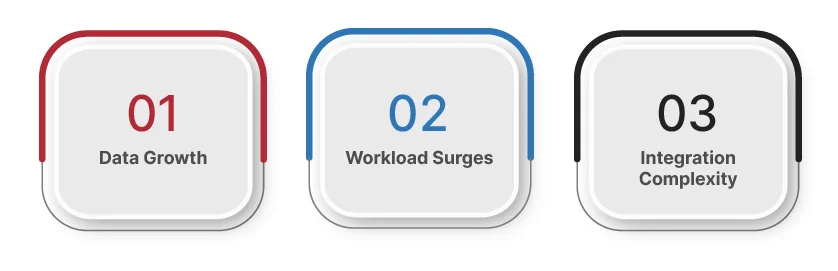
Data Growth:
A lack of database query optimization and poor models can delay response times. Analyzing database bottlenecks will reveal slow queries that were acceptable at low scale but collapse under load.
Workload Surges:
AI workloads, demand spikes, and batch analytics stress systems in unpredictable ways. Without stress testing and user load testing, capacity assumptions become invalid.
Integration Complexity:
Enterprises these days are using interconnected systems. A single slow API can cause delays across platforms, creating a huge negative impact on user experience.
Let’s take a quick look at the impact of some common bottlenecks and why removing them is important for enterprise application architecture and sustainable performance optimization:
| Bottleneck Area | Technical Cause | Business Impact |
| Database layer | Inefficient queries, locking | Delayed transactions, reporting failures |
| API layer | High latency, rate limits | Broken customer journeys |
| Application layer | Thread contention, memory leaks | Reduced throughput |
| Infrastructure | CPU and memory monitoring gaps | Cost overruns, instability |
Building Continuous Performance Intelligence for Scale
A scalable enterprise application does not rely on one-time validation practices or periodic performance reviews. As it grows with new features, AI-based functionality, and integrations, the performance benchmark also changes. Software performance testing only confirms a system’s behavior at a specific moment, which does not fit with real-world usage patterns.
Continuous performance intelligence eradicates this gap by combining APM, resource monitoring, and deep application profiling. CPU and memory monitoring telemetry data, thread behavior, API calls, and database queries are collected and correlated to create performance baselines. In case deviations occur, your team can perform faster root cause analysis of performance issues. This also improves bottleneck detection methods by revealing early stress signals that traditional monitoring often overlooks.
Instead of following the reactive approach, leaders should use predictive insights to understand how their application release is not to be affected. Automated quality gates will also ensure new code changes do not lead to regression.
Why TestingXperts for Enterprise App Performance Testing Services?
TestingXperts utilizes bottleneck detection tools with domain expertise to help enterprises eliminate software performance bottlenecks. We help you move from reactive fixes to engineered scalability. The outcome is a predictable scale, improved user experience, resilient performance, and reduced downtime. Our enterprise app performance testing services focuses on:
- Scalability errors diagnostics by analyzing enterprise applications in real operating conditions to create performance breakdowns.
- Structured performance engineering frameworks to ensure remediation is targeted, repeatable, and aligned with business risk.
- Using in-house accelerators and GenAI-powered Framework QXcel to speed up bottleneck detection methods and reduce time-to-insights.
- Deliver architectural insights through profiling and tracing applications and identifying and resolving constraints to guide the modernization process.
- Resilient enterprise app performance, reduced downtime, and better customer experience driven by stable response time.
Conclusion
Enterprise applications are now dynamic platforms that can scale effectively in response to growing data, increasing integration complexity, and AI workloads. However, if performance fails to scale, the results will negatively impact your business’s ROI. You must consider performance optimization as a regular task, supported by intelligent testing, architectural insight, and continuous monitoring. TestingXperts enterprise app performance testing services helps you uncover scalability constraints early and optimize application performance. We leverage proven bottleneck detection methods and application profiling tools to assess performance breakpoints, ensuring your application is ready for the next demand curve.


Manjeet Kumar
VP, Delivery Quality Engineering
Manjeet Kumar, Vice President at TestingXperts, is a results-driven leader with 19 years of experience in Quality Engineering. Prior to TestingXperts, Manjeet worked with leading brands like HCL Technologies and BirlaSoft. He ensures clients receive best-in-class QA services by optimizing testing strategies, enhancing efficiency, and driving innovation. His passion for building high-performing teams and delivering value-driven solutions empowers businesses to achieve excellence in the evolving digital landscape.
FAQs
How do you prevent performance regressions in future releases?
We use automated regression performance tests, baseline comparisons, and CI/CD-integrated monitoring to detect deviations early and prevent performance degradation in new releases.
What are the most common bottlenecks that degrade Enterprise Application Performance at scale?
Common bottlenecks include:
- Inefficient database queries
- Poor API response handling
- Infrastructure limits
- Memory leaks
- Improper load balancing under peak traffic
What are the most common causes of application performance issues in large-scale enterprise systems?
Performance issues often result from unoptimized code, high concurrency loads, database contention, network latency, and inadequate capacity planning.
How do you establish performance benchmarks and a baseline for business-critical transactions?
At TestingXperts, we measure response times, throughput, and resource usage under controlled loads to define stable benchmarks for critical business transactions.
What deliverables do we receive from an Enterprise Application Performance engagement?
You receive performance test reports, bottleneck analysis, benchmark metrics, improvement recommendations, and test execution results.
How do you handle test data management and masking to run realistic performance tests safely?
TestingXperts uses anonymized, masked production-like data and synthetic datasets to ensure realistic performance testing without exposing sensitive information.
Discover more